Accessed Port at Home
Important information about accessed ports:
-
Learn more about an accessed implantable venous port (the needle is in the port).
-
Central line or catheter: The central line itself may be referred to as the "central line" or also the "catheter." This refers to the device itself and is different from the tubing that might be attached to your child's central line.
-
Dressing: Your child's central line has a clear, sterile dressing over the spot where the catheter comes out of the skin (exit site). A nurse will change this dressing once a week. During the dressing change, they will wear a mask. You and your child will also need to wear masks when the dressing is changed.
-
Cap: There is a cap attached to the end of the catheter. This cap is changed once a week by a nurse, usually at the same time as the dressing change. Everyone, including the nurse, your child, and you, must wear a mask during the cap change.
-
Flushing: When your child is not getting medicine or fluids through the central line, blood can back up into the catheter and cause a blockage (clot). To prevent this, the catheter is flushed with heparin.
Having a central line increases your child’s risk for infection. You may hear the team call this a “CLABSI,” which stands for central line–associated bloodstream infection. Find more information here. Your team will partner with you to reduce the risk of infection at home.
Call your clinical team right away if your child has signs of an infection:
-
The central line site is painful, red, puffy, or draining
-
Your child has a fever, poor appetite, or is sleeping more than usual
-
Your child is cranky, crying more than usual, or less active than normal
Instructions for cleaning hands:
Always clean your hands with soap and water before touching your child’s central line or any supplies.
-
Turn on the water and wet your hands and wrists.
-
Use liquid soap from a pump dispenser to scrub your hands for at least 15 seconds, making sure to cover all surfaces.
-
Rinse your hands
-
Dry your hands with a clean paper towel. Use this paper towel to turn off the faucet.
-
Once you wash your hands, only touch your supplies. If you touch anything else, clean your hands again.
Alcohol-based hand sanitizer can be used for cleaning between care steps.
-
Use enough sanitizer to be able to rub your hands together for at least 15 seconds, covering all surfaces.
-
Allow the hand sanitizer to dry completely.
The healthcare team may use gloves, but at home, clean hands are best. Chipped nail polish, long nails and gel nails carry more germs and make it harder to keep hands clean.
Instructions for routine care:
Keeping the line safe and secure
-
Never use scissors or anything sharp near the catheter or tubing.
-
The central line catheter and tubing should not dangle or fall near the diaper area.
-
Dress your child in snug-fitting clothes to prevent pulling on the catheter and tubing.
-
Attach tubing to your child’s clothes to avoid tugging. Use a device like Velcro® Hugs.
-
Securement devices, like a Grip-lok®, can be directly on your child’s skin below the dressing to keep the line in place. Make sure it sticks firmly to the skin and the line is not moving or sliding. You can replace this securement device if needed.
-
Talk to your care team for more ways to hold the line in place.
Home hygiene
Keeping your child clean through daily mouth care, regular hygiene, and clean linens is important to help prevent central line infections. For bathing and hygiene tips at home, see Home Hygiene for Your Child with a Central Line.
Preventing contamination
-
Vomit, stool, saliva, other body fluids, and even bath water can cause an infection if they get on the dressing, catheter, cap, or tubing.
-
There are products to help keep the line clean and dry. Ask your team about:
Checking the line
Check the central line at least 4 times each day, including:
-
When your child wakes up and before going to bed
-
Before doing any central line care
-
After changing clothes
-
Before leaving the house and after returning
-
Before and after bathing
-
Before and after exercise or any strenuous activity
-
After possible contamination, like vomiting, leaking G tubes, or diaper accidents
To check the central line, look and gently feel the dressing to make sure that:
-
The dressing is clean, dry, and sticks well.
-
The central line exit site and length of line looks unchanged.
-
The cap on the end of the catheter is clean.
-
All connections are tight.
-
All products that protect the line are in place.
-
The line is positioned away from dirty areas like diapers and feeding tubes.
Call the team managing your central line to discuss any concerns from your line check.
What to bring when you leave the house
Each time your child leaves home, bring a set of back-up supplies in case there’s a problem with the central line, including contact numbers and supplies for urgent dressing and line issues. Your team may provide you with a “go-bag” or you can assemble one.
When to call for a dressing change
Your child may need an early dressing change by a trained nurse in certain situations. Call your care team for guidance and to arrange a same-day dressing change in the situations below. While you wait for the nurse, you may need to reinforce the dressing.
-
The dressing gets wet. Even small drops of water mean it must be changed.
-
The dressing is lifting, and less than 1 to 1.5 inches are stuck to the skin around where the line enters.
-
The dressing is soiled or bloody. If actively bleeding, apply pressure to the site.
-
You see moisture collecting under the dressing.
-
All four sides of the dressing have been reinforced.
-
The whole dressing is damaged or has come completely off. Cover the site fully while you call for a same-day dressing change.
If an edge of the dressing is loose, lifting or rolling, but none of the issues above are happening, then you can reinforce the dressing.
Instructions to reinforce the dressing:
-
Clean your hands with soap and water or hand sanitizer.
-
Wipe scissors with an alcohol pad. Open the dressing package. Do not cut the package. Trim the dressing to be large enough to cover the entire edge of the dressing that needs to be reinforced.
-
Use the trimmed dressing to stick down any loose, lifted, or rolled edges. Do not cover the whole dressing.
Instructions for flushing the line:
Heparin comes in different strengths. Your healthcare provider will prescribe the right one for your child. If the central line is not being used, you must flush it with heparin once a day to keep a clot from forming. Lock therapy may impact the timing of flushes.
If your child is getting IV antibiotics or parenteral nutrition (PN), flush the catheter with saline before giving the medicine or PN to make sure the catheter is working. After the antibiotic or PN is done, flush again with saline, then with heparin.
Flushing the central line catheter
-
Pick a clean, well-ventilated, draft free place to work. Avoid the bathroom or kitchen as these areas may have more germs in them. If you must use the kitchen, avoid areas where you prepare food.
-
Select a clean surface to work on. Clean the surface with an antibacterial cleaning solution every time. Some families use a plastic tray only for central line care.
-
Gather your supplies. Never use anything sharp near the catheter—no scissors.
-
Alcohol pads (or the cleaning device you were given)
-
Normal saline flush syringe
-
Heparin flush syringe
-
Protective alcohol cap and any other protective devices in use
-
Wash your hands with soap or use alcohol based-hand sanitizer for 15 seconds.
-
Before you start, check the central line catheter and dressing as described above. If anything is not right, pause to contact your care team before completing the next steps.
-
Prepare the flush syringe:
-
Tap the side of the syringe to move any air bubbles to the top.
-
Remove the cap and set it down right side up. Make sure nothing touches the inside of the cap or the syringe tip.
-
Hold the syringe and gently push the plunger with your thumb. You may meet some resistance.
-
Keep pushing until a drop of liquid comes out and there are no air bubbles.
-
Carefully put the cap back on until you're ready to use the syringe.
-
|
|
|
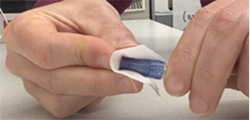
Scrubbing the cap with an alcohol wipe.
|
Scrub the catheter cap with an alcohol wipe for 15 seconds. Position one finger on top and others to the side when scrubbing the cap with alcohol. Let it air dry for 15 seconds. Do not blow or fan it.
-
Remove the syringe cap. Twist the syringe onto the catheter, turn to the right until snug.
-
Unclamp the catheter.
-
Push the fluid in slowly using a push-pause motion. This means pushing in 1ml of fluid in quickly and pausing in between until the full flush is given.
-
Use the amount of saline and heparin your team told you to flush the line.
-
Keep pressure on the syringe plunger while you clamp the catheter.
-
If the catheter is harder to flush than usual, leaking, or bulging, stop. Check the clamp is open, tubing is not kinked, and connections are snug.
-
If it’s still hard to flush, clamp the line and remove the syringe. Call your care team immediately. Never force when flushing.
-
If there is a break, a leak from the line or a bulge, clamp above the area of concern and cover it with sterile gauze and a dressing. Call your care team immediately.
-
Twist off the syringe and throw it away. Make sure the catheter cap is still snug and the inner portion has bounced back to position.
-
Place the alcohol protective cap and any other protective devices in use.
Instructions for responding to problems:
Most children do not have problems with their central line. But if something does happen, it’s important to know what to do. Remember, when in doubt clamp and call!
Call 911 right away if:
-
Your child’s skin looks pale, gray, or blue
-
Your child has chest pain, trouble breathing, coughing, or fainting
-
Clamp the catheter. Place your child on their left side with their head lower than their chest. This helps trap any air in one part of the heart.
Call your clinical team or 911 immediately if:
-
Your child has swelling in the neck, chest, hand, or arm.
-
Stop all fluids running through the catheter.
|
Cap problems
If the cap or tubing connections get dirty or wet
-
If infusing, stop the infusion, unless your team has told you not to for certain infusions (such as continuous cardiac infusions).
-
Clamp the line and keep the end pointed down. Do not flush or use the line until speaking with your team.
-
Call your care team to discuss next steps. A same-day cap change may be needed.
-
Throw away the tubing. It cannot be cleaned or reused.
If the cap comes off
-
Clamp the catheter right away.
-
Keep the end of the catheter pointed down.
-
Cover the open end with sterile gauze or an alcohol pad and wrap Tegaderm® or tape around to keep it in place.
-
Call your care team immediately.
-
Do not change or replace the cap unless your care team tells you to.
Port needle comes out:
-
Remove dressing by gently lifting and peeling from the skin.
-
Dispose of needle in safe manner by placing it in an empty plastic container (examples: milk carton or laundry detergent bottle) and contact your county to schedule a hazardous waste pick-up.
-
If the site is bleeding, place an adhesive bandage over the site.
-
Call your care team.
If blood backs up into the line
-
Check that the line is clamped and make sure the catheter cap is snug.
-
Check if the pump is running, if it should be infusing.
-
Disconnect the tubing right away if the infusion is complete.
-
Flush the line using the push-pause method as you were taught.
If the infusion pump is alarming or the catheter is harder to flush
-
Check that the clamp is open and there are no kinks in the tubing.
-
Never forcefully flush the central line. This can damage the line.
-
Call your infusion pharmacy. They are available 24 hours a day for urgent issues.
Call your CHOP healthcare team with any questions and as directed in these instructions:
Call the office of the healthcare provider or team who ordered the port to be placed:
8:30am-5:00pm, Monday - Friday:
Call that office
Evenings, nights, weekends, and holidays:
215-590-1000 and ask to speak to the Fellow on call for that specialty.
If your child is an oncology patient, call the CHOP oncology team:
|
Buerger patients
8:30am-4:30pm, 7 days a week
(including holidays)
215-590-2299 (select phone nurse)
|
Every day after 4:30pm, all patients
215-590-1000, ask the hospital operator
for the oncology provider
|
|
Voorhees patients
8:00am-4:30pm, Monday-Friday
856-435-7502
|
Weekends and holidays, all patients
8:30am-5:00pm
215-590-2299 (select phone nurse)
|
|
King of Prussia patients
8:00am-4:30pm, Monday-Friday
267-425-3320
|
|
Reviewed May 2025 by Jean Abraitis, BSN, RN, Maureen Baylis, MSN, RN, Katy Murtaugh, BSN, RN, Lauren Le Goff, MS, CIC, Samantha Steich, BSN, RN, Melanie Brandan MSN, RN, VA-BC, Megan Lynch, MSN, RN