Low-Profile, Non-Balloon Gastrostomy Tube
Important Information:
-
Low-profile, non-balloon silicone gastrostomy tubes, also called button G tubes, have a mushroom-shaped bumper at the end. The mushroom bumper lies against the inside of the wall of the stomach. they may also be called a Bard® button or MiniOne® capsule button.
-
Low profile means that the part of the tube on the outside of the stomach lies flat against the skin of the belly.
-
The mushroom-shaped bumper has a one-way valve that works like a trap door. When the valve is closed, nothing can pass through. To give feedings or medicines, a special tube called an extension set is attached. The G tube also comes with decompression tubing to release air from the stomach. This is called venting.
-
G tubes need to be changed routinely; your team will tell you how often.
-
Your child's tube should not affect normal activities. Your child can bathe, play, swim, and sleep as usual. This kind of tube works especially well for the active child because there is nothing hanging out to get caught on, and it is easily hidden under clothing.
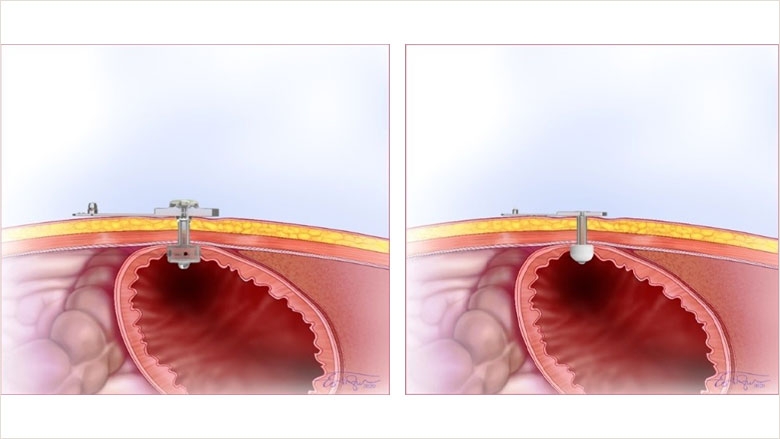
Two examples of low-profile, non-balloon button G tubes in the stomach |
Instructions for attaching and removing the extension set:
-
Hold the button firmly with one hand.
-
Open the safety plug on the button and insert the extension set completely, using a slight twisting action and pushing pressure.
-
When a feeding is finished, flush the tube as you have been taught and remove the extension set with a slight twisting action and pulling pressure.
-
Removing the extension set can prevent your child from pulling on the tube.
Instructions for cleaning the extension set:
-
Wash the extension set in warm, soapy water after each use.
-
Rinse well and hang to dry.
-
Clean the ENFit® connection ports on the extension set every day using a toothbrush and water.
-
Ask your homecare company how many sets you will be receiving each month so you know how often you can change them.
Instructions for skin care:
The stoma site is the opening where the G tube is inserted into the stomach. Wash around the stoma site and surrounding skin with mild soap and water every day, or more often if needed. Be gentle. Scrubbing can slow down healing or cause skin breakdown. Rinse with water and dry well. It is normal to have a little yellow-brown drainage and redness at the opening.
Turn the tube each say and secure it in a different position to help prevent skin injury.
Call your child's healthcare provider if you see:
-
Rash with red dots on the edges
-
Signs of infection: increased redness, swelling, yellow-green drainage with a bad smell at the stoma, pain
-
Open areas of skin around the stoma
-
Bleeding at the stoma site
-
Bleeding, painful or growing granulation tissue around the stoma
-
Increased leaking (formula or stomach fluid) at the stoma site
Instructions for leaking:
-
Call your healthcare provider if the tube is leaking.
-
While you are waiting to get instructions, keep your child's skin dry by changing any wet gauze or dressing under the tube as needed.
-
Protect the skin around the stoma with a skin barrier, such as Vaseline® , A&D® ointment, diaper cream, or Cavilon™ No Sting Barrier Film (if your child is over 1 month of age).
Instructions for treating granulation tissue:
Granulation tissue is a type of scar tissue that forms when the body is trying to heal itself. Because the feeding tube stoma is a new opening, your child's body naturally may try to close it by growing this tissue. Some children have granulation tissue that grows very quickly, while others have no problem with it at all. Granulation tissue is dark pink or red. Sometimes it can cause leaking and skin irritation. It may also bleed or cause pain. If this happens contact your healthcare provider.
-
If you see granulation tissue starting to grow, discuss it with your healthcare provider at your next visit.
-
If the granulation tissue around the tube is bleeding, painful, or growing quickly, contact your healthcare provider for an appointment. They may prescribe a cream that you can use at home, or they may treat it in the office with a medicine called silver nitrate. These medicines shrink the granulation tissue. Granulation tissue may return and need to be treated with medicine again.
Instructions for venting the G tube:
Venting is a way to use the tube to burp your child and let gas out of their stomach. Your child may need to be vented if their belly is bloated, if they have belly pain, or if they gag, retch, or vomit.
If your child's tube needs to be vented, follow these steps:
-
Place the decompression extension set into the button.
-
Remove the plunger from a 60ml oral syringe and attach the open barrel to the decompression extension set.
-
Keep the tube vented for 5-10 minutes before and after feeding or as instructed.
-
If this does not work, turn the decompression tube to open the valve.
Instructions if the G tube becomes clogged:
-
Try to prevent the tube from clogging by flushing the tube with water as directed after each feeding and before and after each medicine. If your child is on continuous feedings, the tube needs to be flushed at least once a day.
-
Even a tube that is not being used must be flushed once a day.
-
If the tube becomes clogged, attach a 30 ml or 60 ml oral syringe to the tube and pull the plunger back to help loosen the clog. Fill the 30 ml or 60 ml oral syringe with warm water and attach it to the end of your feeding tube. Try to flush the tube. If you are unable to flush, gently pull back on the plunger of the syringe to help loosen the clog. Try to flush the tube. If you still cannot flush the tube, remove the syringe and clamp the tube. Let the warm water soak in the tube for up to 20 minutes, then attach the 30 ml or 60 ml oral syringe to the tube and try to flush.
-
If this does not work, call your healthcare provider.
Instructions if the G tube comes out:
No matter how long your child has had a G tube, the stoma can close very quickly. If the G tube comes out and you are:
-
If you are less than 45 minutes away from one of CHOP's hospitals, go to the nearest CHOP Emergency Department in Philadelphia or King of Prussia.
-
More than 45 minutes away from CHOP, go to the closest Emergency Department. If you go to another Emergency Department, ask them to call your child's healthcare provider at CHOP.
Watch the video below on cleaning ENFit feeding tube ports:

https://info.chop.edu/3NdBDAr
Call your CHOP team with any questions or concerns.
|
Interventional Radiology
8:00am-4:30pm, Monday-Friday
215-590-7000
Every day after 4:30 pm, weekends and holidays
215-590-1000, ask the hospital operator for the interventional radiologist on call
|
General Surgery 7:00am-5:00pm, Monday-Friday
215-590-2730
Every day after 5:00 pm, weekends and holidays
215-590-1000, ask the hospital operator for the general surgeon on call
|
| Gastroenterology (GI) 8:30am-4:30pm, Monday-Friday
267-425-2739
Every day after 4:30 pm, weekends and holidays
215-590-1000, ask the hospital operator for the GI fellow on call
|
|
Reviewed May 2025 by Lauren Agzigian, CRNP, Carly Ehritz, MSN, RN, January 2026 by Carly Ehritz, MSN, RN, ACCNS-P