Intramuscular (IM) Injections
The medicine prescribed for you or your child must be given into a muscle. This is called an intramuscular (IM) injection.
Patient Instructions:
-
Let the medicine reach room temperature. This decreases bruising and pain when giving the medicine.
-
You can apply an ice pack to the site for a few minutes to numb the area. Place the ice pack over a layer of clothing and not directly on the skin. Your health care provider may order a numbing medicine.
-
Keep muscles in the injection area relaxed.
-
If you are giving the injection to your child:
-
Prepare the injection before approaching your child.
-
You may need a second person to hold your child while you give the injection.
-
Approach your child in a calm, but firm manner.
-
If your child is old enough to understand, explain why they need the injection. You may need to explain this every time you give the injection.
-
Distract your child with a toy, a movie, a book, by squeezing a hand or an object, by sucking on a pacifier, or any way that may be helpful.
-
Explain to your child that it is okay to cry, but they must be still.
-
Do not expect your child to adjust to receiving the injection.
-
Comfort and praise your child after you give the injection.
Gather Supplies
-
Ice pack (if you want to numb the area) or numbing medicine (if ordered)
-
Safe, clean work area to prepare the injection
-
Alcohol swabs
-
Cotton balls or gauze
-
Bandage (if you or your child want one)
-
Hard plastic container for disposal of used syringes and needles
-
Disposable syringes with needles
-
Medicine
-
Each drug company and pharmacy may have their own way of mixing this medicine. Even if your child’s dose does not change, the amount you need to draw up into the syringe may change. It depends on the way it was mixed. Each time you fill or refill a prescription, have the pharmacist show you exactly how much medicine to draw up into the syringe.
-
Caution: Keep medicine, syringes, and supplies out of the reach of children.
Prepare the Injection
-
Wash and dry your hands or use hand sanitizer.
-
Read the label on the bottle each time you prepare the medicine. Check the label for:
If you are using a vial (bottle):
-
Remove the plastic cap on the medicine vial.
-
Scrub the top of the medicine vial with alcohol and let dry.
-
Attach the needle to the syringe. Do not touch the needle. Keep it sterile (germ-free).
-
Take off the needle cap or needle guard. Pull back the plunger on the syringe until it reaches the correct line. Pull back the same amount of air as the amount of medicine you need.
-
Insert the needle into the rubber top on the medicine vial. Push down on the plunger to push the air into the vial. Keep the needle in the vial.
-
Turn the vial with the attached needle and syringe so the bottle is on the top and the syringe is on the bottom.
-
Make sure that the tip of the needle is below the level of the liquid in the bottle. Pull back slowly on the plunger until you are a little bit past the line that marks the dose. Keep the tip of the needle in the medicine.
-
Tap the syringe to send any air bubbles to the top. Push on the plunger to push any air bubbles out of the syringe.
-
Check that the right amount of medicine is in the syringe.
-
Turn the vial so it is on the bottom and take the needle out of the bottle.
-
Recap the needle and set it aside.
If you are using a prefilled syringe:
Prefilled syringes may come with a needle or a cap on the end of the syringe.
If you need to attach a needle to the syringe:
-
Peel open the needle package. Do not touch the uncovered end of the needle.
-
Twist the cap off the syringe.
-
Do not touch the tip of the syringe.
-
Twist the needle onto the end of the syringe.
-
Push up on the plunger until a drop of medicine appears at the needle tip.
-
Check that the right amount of medicine is in the syringe. If you are not using the full amount of medicine in the syringe, carefully squirt out the extra medicine until the plunger lines up with the correct amount for the dose.
Choose the Injection Site
Your health care provider may ask that you only use one site.
-
The outer thigh may be used for children of all ages.
-
The hip may be used for children over 7 months of age.If you are giving the injection to yourself, the hip can be difficult to reach and is not recommended.
-
The upper arm may be used for children over 1 year of age if there is enough muscle. Ask your healthcare provider.
-
The buttock should not be used unless you have been told to do so by your healthcare provider. They will teach you how to do this.
|
Outer Thigh
-
The person getting the injection should lie on their back. A child can sit on an adult’s lap.
-
Bend the knee to relax the thigh muscle.
-
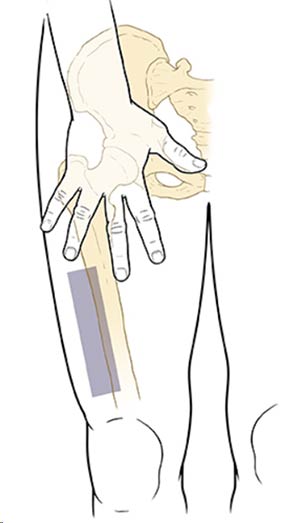
Picture the top of the thigh as a long rectangle.
-
Place the palm of your hand on the front of the thigh where it meets the groin.
-
The space just below your fingertips is the top of the rectangle.
-
The space just above the knee is the bottom of the rectangle.
-
Imagine a line going down the middle of the front of the thigh. This is one long side of the rectangle.
-
Imagine another line going down the outside of the thigh. This is the other long side of the rectangle.
-
Imagine a line down the middle of the rectangle that goes from the hip to the knee. The best place to give the injection is anywhere along this middle line. See image at right.
|
 |
|
Hip (not recommended for self-injection)
-
Have your child lie on their side with their knee bent and leg brought forward.
-
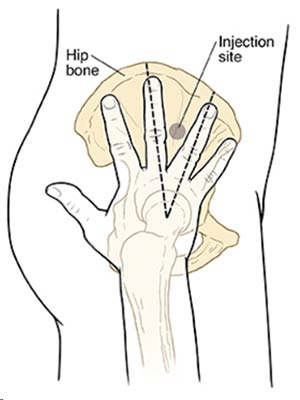
Find the place where the thighbone meets the hip bone. It is a bony, ball-like area.
-
Place your hand over this area.
-
If you are giving the injection to your child, your fingers should point upward. Look for the V shape between your middle finger and ring finger. The injection site will be in the space between the knuckles on your middle finger and your ring finger. See image at right.
|
 |
|
Upper Arm
-
If you are giving the injection to a child, have them sit still or have an adult hold them on their lap.
-
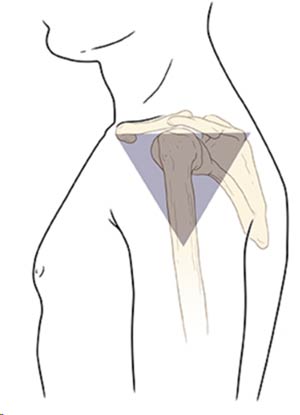
The injection site will be on the outside of the upper arm. Imagine an upside-down triangle there. You will inject into the center of the triangle.
-
Touch the bone at the top of the upper arm, where the arm meets the shoulder. This is the top of the upside-down triangle.
-
Move your hand about 3-4 inches down the outside of the upper arm, to the level of the arm pit. This is the bottom point of the triangle.
-
The injection site is in the center of the triangle, about 1 to 2 inches below the bone at the top of the arm. See image at right.
|
 |
Give the Injection
-
Clean the injection site with alcohol. Allow the skin to completely dry.
-
Remove the needle cap. Hold the syringe like a dart or a pencil.
-
Grasp the muscle firmly between your thumb and other fingers to stabilize the muscle. If the person getting the injection is obese, firmly stretch the skin with your thumb and index finger and grasp the muscle deeply on each side. If the person getting the injection is very thin, pinch up the fat and muscle.
-
Hold the needle at a 75-90° angle (straight up and down) to the skin. Insert needle quickly and smoothly.
-
Inject the medicine slowly into the muscle by pushing the plunger all the way down into the syringe. Inject at a speed of about 10 seconds for each ml of medicine.
-
Remove the needle quickly. Hold a dry cotton ball or gauze over the site until any bleeding has stopped. Do not rub the site. Rubbing could make the medicine leak out.
-
Cover the site with a bandage if you wish.Do not recap the needle. Dispose of the syringe and needle in a hard container (needle box or laundry detergent bottle). You will need to find out what services are available in your area to dispose of the container.
Your healthcare provider, pharmacist, local health department, township office and state Department of Environmental Protection can give you more information about safe needle disposal. www.safeneedledisposal.org
Helpful Tips
-
Make sure you have enough medicine and supplies.
-
Plan ahead for weekends and vacations.
-
Renew prescriptions before your supply runs out.
-
When you renew the prescription, always read the label.
IM injection learning module:

https://info.chop.edu/3TdLuqO
Reviewed October 2024 by Linda Kocent MSN, RN, NEA-BC