Caring for a Child in a Hip Spica (Body) Cast
Instructions for home care of a child in a hip spica (body) cast:
Safety
Cast care
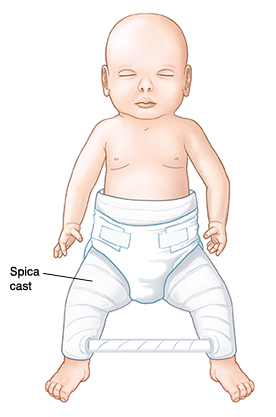 |
-
Keep the cast dry. Your child will need sponge baths while in the cast. If the cast becomes wet, it can hurt your child’s skin.
-
Do not put anything down inside the cast. This can cause a sore or an infection. Protect the cast with a towel or large bib from small toys, dirt, or pieces of food.
-
If your child complains of itching, use a blow dryer set on cool to blow air down the cast.
-
If your cast has a waterproof Gortex® lining do not tape it. Removing the tape will cause Gortex liner to tear.
-
Protect the cast from urine and stool. If the lining becomes thin or tears, it is ok to use duct tape to repair the tear.
-
If the cast edges become sharp, it is ok to use duct tape to smooth the edges.
Image used with permission from The Staywell Company, LLC
|
Skin care
-
Check the skin daily for sore areas. Use a flashlight to look inside the cast.
-
When your child is awake, change your child’s position at least every 2 hours. Lying in one position in the heavy cast can cause skin sores under the cast.
-
Use pillows, blanket rolls, or chair cushions for support.
-
Put a pillow or blanket roll under the lower leg (not under the heel) to keep the heels off the bed.
-
It is ok to do tummy time as tolerated with a pillow under the chest.
-
Do not use lotions, oils, or powder on the skin under the cast.
-
Check your child’s toes daily. They should be warm and pink. Your child should be able to move their toes. The toes should not be swollen.
Diet
-
Your child may want to eat small, frequent meals instead of 3 meals a day.
-
Your child should eat a well-balanced diet and drink lots of fluids.
Going to the bathroom
If your child wears diapers, tuck the edges of the diaper up under the edges of the cast. This keeps urine and stool inside the diaper and keeps the cast from getting damp and dirty. Then place a large diaper around the outside of the cast for excess.
-
You can put a sanitary napkin, diaper doubler, or incontinence pad (Serenity®) inside the diaper for more protection.
-
Check the diaper often.
-
Depending on the position of the cast, your child may be able to sit on the toilet with your help
-
Boys can use the urinal from the hospital.
-
For girls, a paper cup with a small hole in the bottom may help to direct urine into the bedpan.
Bathing and hair washing
Your child will need to have sponge baths.
Hair washing:
-
For babies, or smaller children, lie on the counter next to the sink to wash hair, using the faucet hose or cup.
-
For larger children, have your child lie crosswise on the bed with their head hanging over the edge. Put a container (a plastic trash can) on the floor to catch the water.
Clothing
-
Clothes should be loose and comfortable. T-shirts should be 1 to 2 sizes larger than usual to fit over the cast. Boxer shorts or sweatpants in a larger size can also fit over the cast.
-
Your child may be warmer than usual. Light clothing may be all that is needed. Breakaway shorts (with snaps on each side) can be used with casts that have a bar connecting the legs of the cast.
-
Babies should use a larger onesie over the cast that snaps at the diaper to prevent food or objects from falling into the cast.
Transportation
Children in spica casts must be safely restrained while riding in cars. They may not lie down unrestrained, face sideways, or sit on laps. There are several options available. This will be discussed with your care team.
Contact your CHOP orthopedic team with questions, concerns or if:
-
Your child has severe pain and pain medicine does not help.
-
You see a change in the cast: cracking, softening, drainage from the inside.
-
You smell a bad odor coming from the cast or lining of the cast is wet.
-
Your child’s toes are cold, blue, gray, or swollen.
-
Your child complains of numbness or tingling in their toes.
-
Your child cannot move their toes.
Weekdays:
215-590-1527
Nights, weekends and holidays:
Call 215-590-1000 and ask the operator to page the orthopedic resident on call.
Reviewed March 2024 by Meg Morro RN, Kate Easby ATC