What to Expect When Your Child Has a Foley Catheter
Important information:
A Foley catheter is a soft drainage tube that is inserted through the urethra and into the bladder. It allows urine to drain into a collection bag or a diaper. There is a small balloon at the tip of the catheter. After the catheter is inserted into the bladder, the balloon is filled with water. The balloon helps to keep the catheter in place.
Who needs a Foley catheter?
-
Sometimes a Foley catheter is needed after surgery to help to drain the bladder. Examples of such surgeries include those that involve the genitals or urinary tract, C-sections and surgeries lasting longer than 4 hours.
-
If your child is critically ill and we need exact measurements of their urine.
-
If your child has trouble emptying their bladder and we cannot improve that by other means such as clean intermittent catheterization (CIC).
-
If your child has skin breakdown in their diaper area and urine prevents that from healing well.
-
To improve comfort during end-of-life care.
-
To promote continuous bladder emptying or to prevent harm during certain cancer treatments.
-
If your child has an epidural (pain management) catheter in place or an epidural catheter has been removed in less than 4 hours.
My child gets clean intermittent catheterization (CIC) at home. Can we switch to a Foley catheter when in the hospital?
We do not recommend stopping clean intermittent catheterization (CIC) during a hospital stay. Placing a Foley in a patient that usually gets CIC increases their risk of urinary tract infection (UTI).
What are the risks of having a Foley catheter?
Instructions for Foley care:
-
Only insert catheters when needed.
-
Use sterile methods to insert the Foley.
-
Use clean methods to protect the Foley after insertion.
-
Make sure that urine flows freely into the collection bag or diaper:
-
No “loops” or “kinks” in the catheter tubing
-
Empty the urine bag often
-
Keep the urine bag upright
-
Remove the catheter promptly when it is no longer needed.
-
Clean the diaper/underwear area at least every 24 hours with soap and water and after bowel movements.
-
Keep the catheter secured to the thigh so it stays in place at all times.
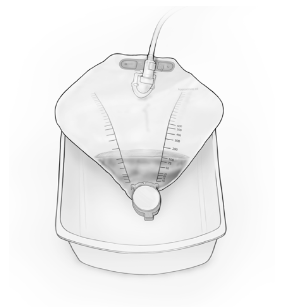
Keep the bag upright at ALL times! No loops or kinks in the line!
 |
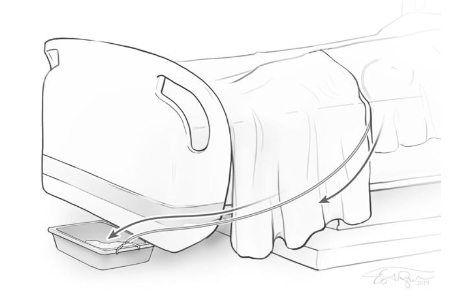 |
| No loops or kinks in the line! |
Keep the bag upright at ALL times! |
Contact your CHOP healthcare team with questions or concerns.
Reviewed January 2024 by Tara Phillips, CRNP