Spine: After Nuss or Ravitch Procedure
The following instructions are for patients after a Nuss or Ravitch procedure to correct the chest wall conditions pectus excavatum and pectus carinatum.
Important information:
After chest surgery, the skin and bones need time to heal. The skin incision takes 2-4 weeks to heal. The bones take 4-6 weeks to heal. Many factors affect the healing process. Healing times are different for each child. Ask your healthcare provider what to expect for your child. Learn more about the Nuss and Ravitch procedures to correct the chest wall.
Patient instructions:
Avoid high impact activities such as running and jumping. Talk with your healthcare provider before your child resumes activities and sports.
Follow the instructions below for 4 weeks after a Nuss procedure and 6 weeks after a Ravitch procedure.
|
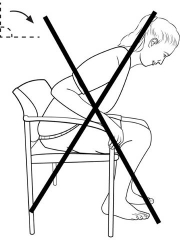
Do not bend past 90 degrees at the waist
-
Do not bend forward to pick things up off the floor.
-
Avoid leaning forward when sitting in a chair.
-
The occupational therapist will review strategies for putting on pants, socks, and shoes with you.
Do not twist at the waist
|
 |
|
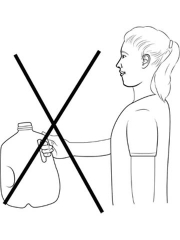
Do not lift anything greater than 10 pounds
-
A gallon of milk weighs about 8 1/2 pounds. Avoid lifting anything heavier than this.
-
Be careful pushing and pulling heavy objects.
-
Avoid using your arms to get into and out of bed or a chair.
Do not lie on your side or stomach
|
 |
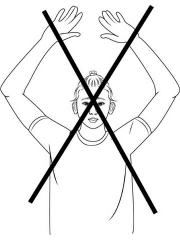
Do not raise arms overhead
-
Do not raise your arms above shoulder level (90 degrees).
-
The occupational therapist will review adaptive strategies for bathing, dressing, and grooming with you.
Do not pull on your child’s arms during transfers
|
 |
Contact your therapist with any questions.
Reviewed August 2025 by Jason Benincasa, PT, DPT, PCS and Natalie Schiano OTD, OTR/L