Undescended Testicle: How to Care for Your Child
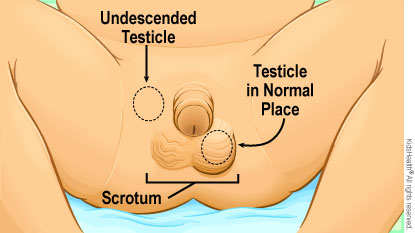
Undescended testicle (also known as cryptorchidism) is when one or both of a baby boy's testicles have not moved down into their proper place in the scrotum.
An undescended testicle may come down on its own in the first few months of life. If it doesn't come down by 6 months of age, surgery is recommended.

-
You may care for your baby as usual.
-
Make any follow-up appointments as directed by your health care provider.
-
Follow up as instructed so your health care provider can check to see if the testicle has come down.

Your baby seems fussy or vomits more than a few times. This might be a sign of twisting of the testicle (testicular torsion).

Your baby:

Are there risks from having an undescended testicle? There are some risks, such as:
-
Testicular torsion (twisting of the testicle)
-
Lower than normal sperm count, which may affect fertility
-
Slightly higher risk of testicular cancer as an adult
Surgery to bring the testicle into the scrotum can help lower these risks. It's best for this surgery to be done before a child is 2 years old.
What is the surgery for an undescended testicle? Usually, the surgery is an orchiopexy (or-kee-oh-PEK-see). In this procedure, the surgeon makes a small cut in the groin, brings the testicle down into the scrotum, then stitches it in place. Most babies go home the day of the surgery and recover fully within a week.