Discharge Instructions: Bone Conduction Hearing Implant
Important information about the implant:
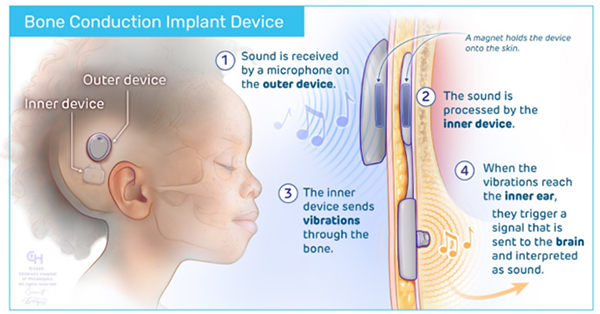
A bone conduction hearing implant is a device that helps people hear by sending sound vibrations through bone to the inner ear (cochlea). The inner ear then turns these vibrations into signals that the brain understands as sound. The implant has two parts. There is an inner device placed under the skin and an outer device worn on the head. This type of hearing aid can help people with conductive, mixed, or single sided hearing loss. It is also used in children born without an ear canal, such as those with Microtia or Atresia.
 |
Placing a bone conduction implant is an outpatient surgery, which means your child will go home the same day. Your child will be given general anesthesia, so they will be asleep and not feel pain or remember the surgery. The surgeon may shave a small amount of hair and will make a small cut (incision) behind the ear on the side where the implant will be placed. The implant is placed in the bone behind the ear, called the mastoid bone. The implant will naturally fuse to the bone over time. This is called osteointegration. After the surgery, the surgeon will place a pressure dressing behind the ear.
Instructions following surgery:
What to expect
Medicines
-
Your child may have pain at the surgical site. They may have pain or discomfort with chewing in the first few days after the surgery. Give your child pain medicine as prescribed by your healthcare provider. Do not give aspirin without asking your surgeon.
-
If your child was given a prescription for an oral antibiotic, give as directed.
-
If your child has ear tubes, give antibiotic ear drops as directed, after the ear dressing comes off.
Activity and diet
-
Your child should drink clear fluids first, such as apple juice, white grape juice or water. If these are tolerated, then they may return to their usual diet.
-
Keep the incision clean and dry for 3 days.
-
Your child should not participate in contact sports for 2 weeks after surgery. Protect the head (as much as possible) from getting banged or bumped, until your surgeon allows your child to return to their regular activities.
-
Contact your ENT provider if an MRI is needed in the future.
-
Your child may return to school or daycare when they are feeling well.
Follow-up appointments
-
You will need an ENT appointment 3-4 weeks after surgery.
-
Schedule an appointment with CHOP Audiology for activation of the implant.
-
Detailed post-operative care continues for a year or more after surgery and can help determine how much hearing and speech improvement your child will achieve. Learn more about general follow-up guidelines.
Contact your CHOP ENT team with questions, concerns or if:
-
Your child’s incision develops swelling, redness, bleeding, or drainage.
-
The edges of the incision open or separate.
-
Your child has a temperature higher than 101F (38.3°C).
-
Pain is not relieved by acetaminophen (Tylenol®) or ibuprofen (Motrin®).
-
Your child has frequent vomiting or dizziness.
215-590-3440
7 days per week/24 hours
1-800-551-5480
Reviewed 5/19/2025 by Anne DeLeo CRNP, CORLN