Giving Your Child a Foley Balloon Enema
Foley balloon enemas are enemas that use a high-volume recipe, customized by your providers to help flush the colon and help with stool evacuation. These instructions are for giving your child a foley balloon enema.
Important information:
-
Children respond to their parents’ attitudes. The way that you explain the procedure to your child will affect how your child tolerates the enema. Do not apologize. Be confident and positive.
-
Reserve at least an hour at a specific time each day to administer the enema. It is important for your child to sit for at least 30 minutes after the enema to help with cleaning out the colon.
-
Provide your child with a book to read, a DVD to watch, or a game to play to prevent boredom.
-
Your healthcare team will tell you how often to give the enema. At first enemas are usually given every day to help empty stool from the colon. As your child progresses without soiling accidents, enemas may be switched to every other day or as needed.
-
It is common for your child to complain about cramping during the first few enemas. The cramping improves with time.
-
Your child’s healthcare provider will tell you the amount of enema fluid that your child needs.
-
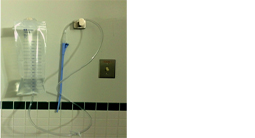
The higher you place the enema bag the faster it is going to flow. You can control the speed of the enema by changing the height and adjusting the roller clamp on the tubing of the enema bag.
-
The goal is to keep stools soft, prevent soiling accidents, and have daily bowel movements.
Instructions for Foley catheter enema:
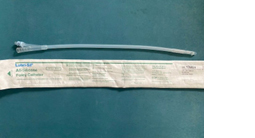
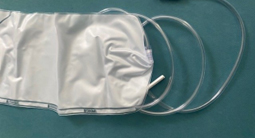
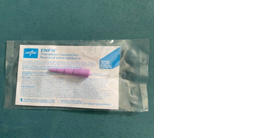
Gather supplies:
-
Old towels
-
Water/saline
-
Table salt (if making saline)
-
Gloves
-
Lubrication jelly - needs to be water soluble
-
Syringe (typically 30mL or 50mL) to inflate balloon
|
|
|
|
 |
|
|
 |
|
|
 |
Prepare the enema
-
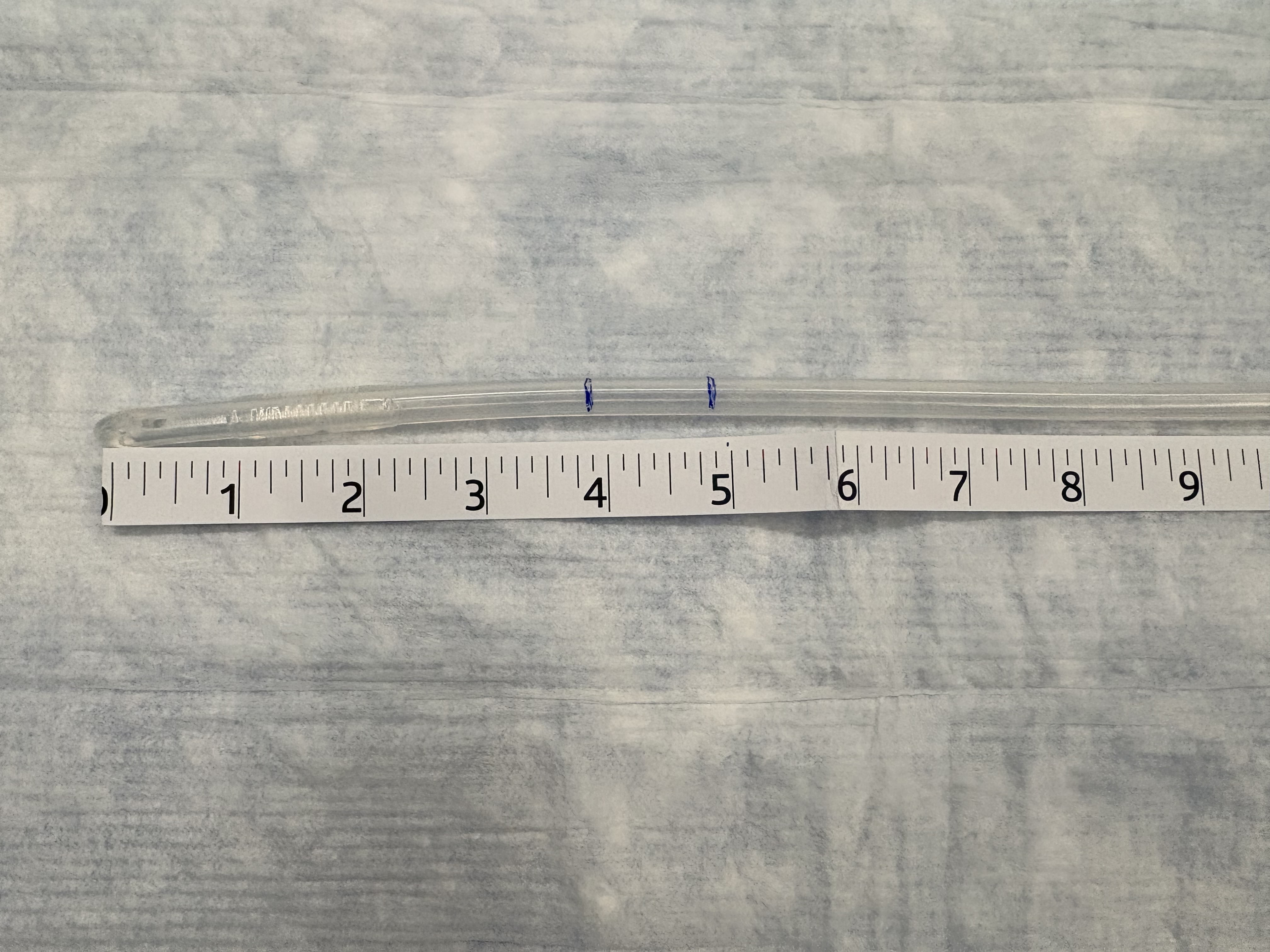
Measure the Foley catheter at 4 to 5 inches and mark with a pen or a marker.
|
 |
-
Make the solution for the enema:
-
Make the recipe for the enema solution as instructed by your child’s healthcare provider.
-
The solution should be warm (body temperature). Cold solution can increase cramping.
-
Test the enema solution by pouring some on the inside of your wrist.
-
Warm the solution before you pour it into the enema bag.
|
|
-
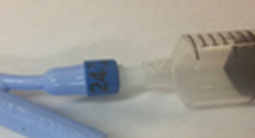
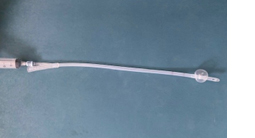
Check the balloon in the Foley catheter to make sure it is working properly.
-
Pull back the amount of air your healthcare team instructed.
-
Attach the syringe to the balloon port on the Foley.
-
Insert the air into the Foley. The balloon at the end of the Foley will expand.
-
Remove the air from the balloon.
-
Keep the syringe attached to the Foley with air in the syringe.
|
 |
-
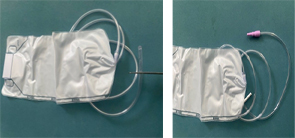
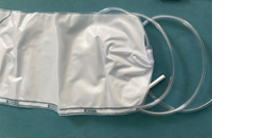
Cut the tubing of the enema bag to remove the part with holes. Attach the connector.
|
 |
-
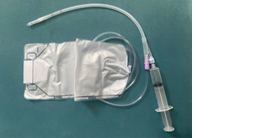
Attach the enema tubing to the Foley catheter using the connector.
|
 |
-
Clamp the enema tubing.
|
 |
-
Hold the enema bag over a sink and add the enema solution to the bag.
-
After the solution is in the bag, open the clamp so that the solution can flow through the tubing of the enema bag and the Foley catheter. When the solution reaches the tip of the Foley, close the clamp.
|
|
-
Hang the enema bag 5 to 6 feet high.
|
 |
Give the enema
-
Put on gloves.
-
Lubricate the end of the Foley catheter.
-
Place old towels on the floor.
|
|
-
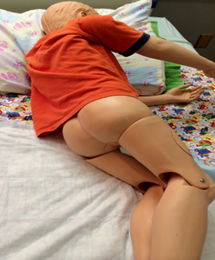
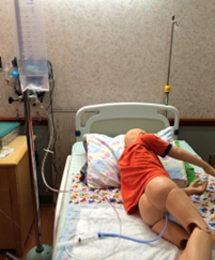
Have your child lie on the towels, on their left side or in the knee to chest position.
|
 |
-
5. Insert the catheter slowly past the 4-inch mark until the catheter reaches the 5-inch mark. Your child may feel the catheter, but there should be no pain.
-
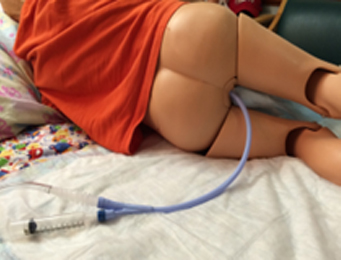
Once the catheter reaches the5-inch mark, inflate the Foley Catheter balloon. The balloon on the catheter acts as a cork and prevents the catheter from coming out of the rectum during the enema administration.
-
Start with the amount of air prescribed by your healthcare team; you can increase in 10mL increments until there is no leaking around the balloon
-
If the enema catheter comes out from the rectum or you note leakage around the catheter balloon, insert more air into the balloon.
-
Pull back the Foley catheter until tension is felt, and the anus is blocked with the balloon.
-
Remove the syringe from the hub of the Foley catheter.
-
If the enema solution is leaking, check if the syringe is attached to the catheter.
-
The balloon deflates automatically if the syringe is left attached.
|
 |
-
Open the clamp and run the enema solution into the colon. Run solution for about 5 minutes or until the enema is empty. If your child complains of cramping, decrease the speed of the enema by lowering the height of the bag.
-
The solution should empty from the bag into the colon.
-
Once the enema bag is empty, clamp the tubing.
-
Have your child hold the enema solution for 10 minutes by lying on the towels with the Foley remaining in the rectum.
-
After 10 minutes, attach the empty syringe back to the Foley catheter syringe port.
-
Pull back all the inflated air from the balloon in the Foley catheter.
-
Remove the Foley catheter from the child’s rectum.
-
Have your child sit on the toilet for at least 30 to 45 minutes to empty the enema solution and stool from the colon.
-
When your child no longer feels the urge to have a bowel movement, the enema is complete.
-
Wash the enema catheter with soap and warm water. Rinse with warm water. Allow it to air dry.
|
 |
Contact your child’s healthcare provider with questions or concerns.
Talk to your healthcare provider about the correct saline mixture for your child.
They may suggest one of the following mixtures:
To make 250 mL of saline: add 1/4 teaspoon of regular table salt to 250 mL warm tap water.
To make 500 mL of saline: add 1/2 teaspoon of regular table salt to 500 mL warm tap water.
To make 1000 mL of saline: add 1 teaspoon of regular table salt to 1000 mL warm tap water.
Common household measurements:
8 ounces = 1 cup = 250 mL
16 ounces = 2 cups = 500 mL
32 ounces = 4 cups = 1 quart = 1000 mL
Watch the video:

https://info.chop.edu/FoleyEnema
Reviewed May 2026 by Keri Dowds, BSN, RN, CGRN, CNE and Lisa Jang, MSN, CRNP