53:B:14g
Preparing Fortified Human Milk with Extensive HA Powder 27 kcal/oz.
For use with:
Your child receives human milk that is prepared with formula to meet their nutritional needs. Human milk calorie concentration varies and it is about 20 calories per ounce (kcal/oz.). A healthcare provider has prescribed your child 27 kcal/oz. of human milk. This is made by adding formula powder to human milk. Use the mixing chart and instructions in this handout instead of the one found on the formula can. Your child’s health depends on following these instructions.
Supplies
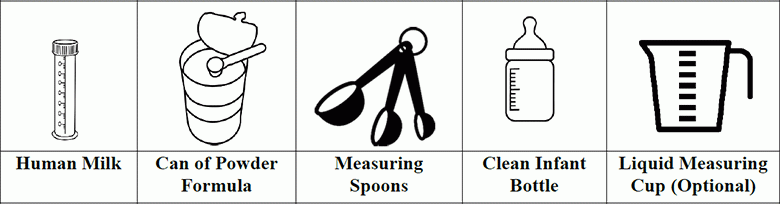
Mixing Chart
Note: There are 30 milliliters (mL) in 1 fluid (fl.) oz. Do not use the scoop that comes in the can of formula.
|
Amount of Human Milk
|
+ |
Amount of Formula Powder
|
= |
To Make About
|
|
2.5 fl. oz. (75 mL)
|
+ |
1.5 tsp
|
= |
2.5 fl. oz. (78 mL)
|
|
5 fl. oz. (150 mL)
|
+ |
3 tsp
|
= |
5 fl. oz. (156 mL)
|
|
10 fl. oz. (300 mL)
|
+ |
6 tsp
|
= |
10 fl. oz. (312 mL)
|
Instructions
-
Gather your supplies.
-
Wash your hands with soap and water.
-
Measure the amount of human milk into a clean, dry bottle or liquid measuring cup. Pour the desired amount into a bottle.
-
Open the can of powder formula and use the right teaspoon to measure. Teaspoons of formula powder should be unpacked and leveled. Do not use the scoop provided in the can of powdered formula.
-
Add the powder formula to the human milk and mix together. Gently shake formula in a closed bottle or stir with a whisk in a liquid measuring cup.
Feeding and storage of prepared fortified human milk
To prevent bacteria growth:
-
Feed fortified human milk to your child or cover container and store in the refrigerator.
-
Throw away fortified human milk that is in the bottle 1 hour after the start of the feeding.
-
Throw away fortified human milk that has been out of the refrigerator for more than 4 hours when given through a feeding tube.
-
Throw away unused fortified human milk 24 hours after making it.
Your child is receiving a high calorie human milk, it is important to watch for:
If your child has these signs, call their healthcare provider.
Reviewed February 2025 by Megan Dougherty MA, RD, LDN and Kristen Dwinnells MA, RDN, LDN