Precocious Puberty Treatment Options
Puberty happens at different times for everyone. Early puberty, called precocious puberty, is when girls show signs of puberty before age 8, or boys before age 9. Children with precocious puberty grow and physically mature sooner than their peers. This means that their bones may mature too quickly and they may stop growing too soon.
Children with early puberty may find it hard to understand and accept the changes in their bodies, which can affect how they feel about themselves. Because they may look older than their age, others might expect them to act older too, which can feel unfair and frustrating.
If tests show that your child has central precocious puberty, there are medicines that can temporarily pause puberty. These medicines are called gonadotropin releasing agonists (GnRHa). They stop the release of the puberty hormones from the pituitary gland. These medicines work best when started before a child is 6 years old. If your child is older than 6, your endocrinologist will discuss whether treatment might help.
Medicines used to treat precocious puberty:
Lupron® and Triptodur® are medicines that are injected into a muscle.
-
Lupron can be given once a month, every 3 months, or every 6 months depending on your child’s needs. This intramuscular (IM) injection is generally given at your primary care provider's office or by endocrine nurses at CHOP.
-
Triptodur is given every 6 months. It must be given by a healthcare professional. In some cases, a nurse can come to your home to give the injection.
Fensolvi® is a subcutaneous (SUBQ) injection that is given directly under the skin. The needle is shorter than what is used for an IM injection. Fensolvi® is given every 6 months. You can be taught how to administer the SQ injection to your child or you can visit your pediatrician or endocrinologist to have the injection given by a nurse.
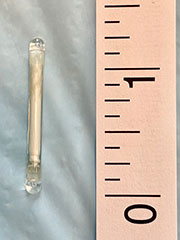 |
| Supprelin LA® implant is just over an inch long |
Supprelin LA® is a small implant that is placed once a year under the skin of the upper arm. It is a tiny, soft plastic tube that slowly releases medicine to stop puberty. The implant can be placed by a healthcare provider during an office visit.
To place the implant, your child’s skill will be numbed, a small cut is made, and the implant is placed under the skin. The cut will be closed with stitches or tape and then covered with a bandage. If your child has completed treatment after a year, the implant is removed. If your child needs to continue with Supprelin LA® for more than a year, the healthcare provider will replace the implant.
Potential side effects of treatment may include:
What to expect with treatment:
During the first few weeks of treatment, girls may have acne, a slight increase in breast size, and sometimes a menstrual period or spotting. Boys may have acne, as well as a slight increase in testicle size. This is normal.
After a few months of treatment, your child’s growth should slow to a more normal rate for their age. Girl’s breasts may become smaller. In boys, testicle size should decrease or stay the same. Pubic hair may stay the same or continue to grow. Treatment usually continues until the child reaches the appropriate age for puberty.
Monitoring while on treatment:
Your child will need a follow up visit with their provider 3-4 months after starting the medicine. Your child will have a physical exam and their growth will be measured. Blood tests may be ordered to check hormone levels. Your child will continue to have physical exams and have growth checked every 4-6 months while they are on puberty blocking medications.
Stopping puberty for many years may decrease bone strength or increase your child’s risk for osteoporosis. Your child’s healthcare team will decide whether your child should have additional testing for bone health.
Reviewed July 2025 by Marissa Kilberg, MD