Positional Plagiocephaly
Important information:
The American Academy of Pediatrics and your child's primary care provider will recommend that your baby sleep on their back. Sleeping on their back reduces the risk of sudden infant death syndrome (SIDS). Because an infant's skull is thin and malleable, it can easily become misshapen, especially if they spend a lot of time on their back. This issue can worsen if a baby tends to turn their head to one side due to tight neck muscles, a condition known as torticollis.
Some children develop positional plagiocephaly, characterized by a flattened, misshapen, or asymmetrical head due to repeated pressure on the same area of the skull. The ear and forehead may also shift forward on the affected flat side, resulting in a “parallelogram” shape. Plagiocephaly is generally considered to have no impact on brain growth or development, and typically does not cause neurological symptoms, even if left untreated.
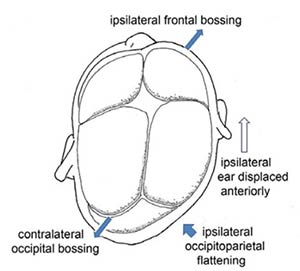 |
| This illustration shows an interior view of the flattening caused by repeated pressure to the same area of the skull. |
Treatment Options
Repositioning
If your baby is very young (around 2-4 months), repositioning is often the primary approach to improve head shape. This involves positioning the baby off the flat side as much as possible. Your child’s healthcare provider may recommend tummy time throughout the day to strengthen the head and neck muscles and prevent further molding. If your baby is diagnosed with torticollis, physical therapy can assist with stretching and improving neck range of motion so they can turn more equally to both sides.
For older children with mild plagiocephaly or if cranial molding isn't preferred, repositioning is the sole treatment. This includes alternating sides during holding and feeds, as well as increasing tummy time. As your child becomes more mobile and begins rolling and sitting independently, they will naturally spend less time with pressure on the back of the head.
Cranial molding helmet
Around 5-6 months of age, a cranial molding helmet may be recommended. This custom-fitted helmet consists of a flexible plastic shell lined with polyethylene foam. It's designed to alleviate pressure on the flat spot and shape the head by redirecting growth.
You will schedule an appointment with a local orthotics company so that your child can be properly fitted for the helmet. However, insurance coverage varies, so it's advisable to check with your insurance company before the appointment.
Regular follow-ups will be scheduled with the orthotics company to adjust the helmet as your child grows and their head shape changes. The helmet is worn for 23 hours a day for several months. The decision to stop helmeting will be based on your observation of improvement, along with evaluation by your child’s neurosurgeon (4-6 weeks after starting the helmet) and orthotist. Remember that as your child grows and their skull thickens, the helmet will become less effective at molding the head shape.
215-590-2780
Reviewed July 2024 by Allison Rodman PA-C