Care for Jackson-Pratt or Hemovac Drain
Important information about Jackson-Pratt (JP) and Hemovac drains:
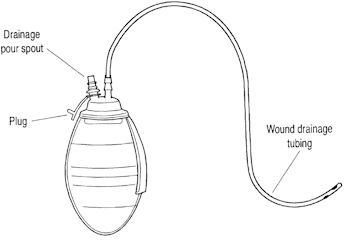
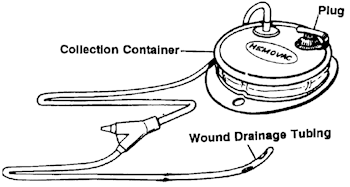
These drains provide gentle suction that prevents blood and fluid from collecting under your child’s incision. It is a piece of tubing that is connected to a container. The tubing is kept in place, near the incision, usually with a piece of tape. You can expect to see bloody drainage in the container.
|
Jackson-Pratt
|
Hemovac
|
 |
 |
General guidelines
-
Don’t sleep on the same side as the tube.
-
Secure the tube and bag inside your clothing. This will prevent the tube from being pulled out.
-
Take a sponge bath to prevent getting your bandage and tube site wet unless your healthcare provider tells you otherwise. Ask your provider when you can take a shower or bathe.
Patient instructions:
Emptying the drain
Empty the drain as directed by your surgical team. Follow these steps:
-
Open the plug of the drain to stop the suction.
-
Empty the fluid into the collection container provided to you at discharge.
-
Measure and record the amount of drainage in a notebook to track the amount of drainage per 24 hours. Bring the daily drain records with you to the follow-up appointment.
-
Squeeze the drain with your hand to re-start the suction. Close the plug while you are squeezing the drain.
-
Flush the fluid in the collection container down the toilet.
-
Clean your toilet bowl with standard toilet cleaning fluid daily.
© 2000-2024 The StayWell Company, LLC. Image used with permission.
Removing the drain
Your drain will need to be removed by a medical professional. Removal time will be determined by your surgical team.
Call your CHOP healthcare team with questions, concerns, or if your child has:
-
Pain, swelling, or fluid around the tube.
-
Redness or warmth around the incision or fluid draining from the incision.
-
Nausea and vomiting.
-
Fever above 101.5°F (38.6°C) or higher, or as advised by your provider.
-
Chills.
-
An incision that does not heal or stitches that become infected or loose.
-
A tube that falls out.
-
A foul smell from the incision site.
-
Drainage that changes from light pink to dark red, or active bleeding.
-
If the drain accidentally dislodges, place it in a plastic bag and call your surgeon’s office.
Reviewed April 2024 by Beverly Teti, CRNP