Hypoglossal Nerve Implant Instructions
Important information about the hypoglossal nerve implant:
The hypoglossal nerve implant is a surgically implanted device used as an alternative sleep apnea treatment.
Implant device size compared to a quarter
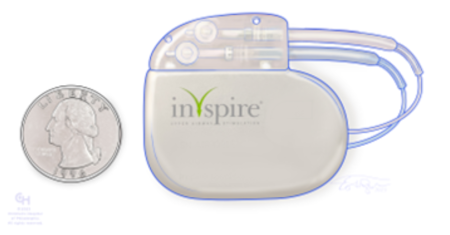 |
| Implant device size compared to a quarter |
-
It is authorized for use in children with Down syndrome (trisomy 21), ages 13 to 18 years old.
-
Children with moderate obstructive sleep apnea who are unable to tolerate a traditional CPAP (continuous positive airway pressure) machine may be eligible.
-
The device monitors your child's breathing at night. It stimulates the tongue to move forward, allowing the airway to remain open while sleeping.
Important information about the surgery:
-
The surgery will require an overnight stay in the hospital. Your child can go home the next day.
-
The procedure is done under general anesthesia. Your child will be completely asleep and will not feel any pain or be aware during the procedure.
-
While your child is asleep, the surgeon will make 2 incisions, one on the right side of the neck just under the jawline. The second incision is on the upper right portion of the chest, where the implant will be placed.
-
We will monitor your child’s tongue nerves during the procedure. Small electrodes are placed in tongue muscles within the mouth to safely monitor the nerves.
-
When the procedure is finished, the surgeon will place a pressure dressing on the chest. This dressing will be removed before leaving the hospital.
-
The incisions are closed with absorbable sutures and surgical tape on top. The surgical tape will fall off on its own in the next few days to weeks.
-
The device will remain off until your child’s activation appointment to allow for healing.
Instructions for care at home after surgery:
Pain and discomfort
-
Your child may have some mild to moderate pain and swelling at the incision sites.
-
This should go away in about 7 to 10 days.
-
Give the prescribed pain medicines as ordered by your surgeon.
-
Unless instructed otherwise by your surgeon, your child will take celecoxib (Celebrex®) for pain following hypoglossal nerve implant surgery.
-
Celecoxib is a safe and effective non-steroidal anti-inflammatory drug (NSAID) like ibuprofen (Motrin®). It is given 2 times a day, often along with other pain relievers such as acetaminophen (Tylenol®).
Bathing
-
Your child may shower 24 hours after the procedure.
-
Do not let the incisions soak or be submerged in water. You may let soapy water run over the incisions and surgical tape.
-
No swimming or baths until your child’s follow-up appointment.
-
Do not rub at the incisions
Activity:
Follow-up appointment
A follow up appointment will be scheduled for your child 1 week after surgery.
Call your CHOP ENT team with questions, concerns or if:
-
Your child has a fever of 102°F (38.8°C) or higher
-
Your child has continued vomiting at home (2 or more times in one day)
-
Your child’s pain medicine is not relieving their pain
-
You notice a lot of bleeding or drainage from your child’s incision sites
-
There is increased pain, swelling, or foul-smelling odor around the incisions
215-590-3440
7 days per week/24 hours
Reviewed February 2024 by Ashley B. Williams, MSN, CRNP-PC, CORLN