Helping Your Child Take Liquid Medicine
Taking medicine can be hard for kids. This guide offers some ideas to make it easier and less stressful for you and your child. Every child is different, and it takes time to find what works best. If you need more help, please reach out to your pharmacist or healthcare provider.
Why taking medicine can be hard for kids
-
Sensory issues: The taste, smell, color, or texture of medicine can bother kids—especially if it’s new or they’ve had a bad experience before.
-
Feeling a loss of control: Taking medicine isn’t a choice, and that can be hard for kids. Kids may feel frustrated. They may say no because they want to be in control.
-
Big feelings or worries: Taking medicine can bring up a lot of feelings. Kids may feel nervous about trying something new, wonder why they need medicine if they feel fine, or worry it could make them feel worse.
How to help your child
Stay calm and patient, and use a kind, honest voice. If one idea doesn’t work, take a break and try something different. Do not call the medicine “candy” or try to trick your child. Instead, let them know it’s okay to feel nervous and explain in simple terms why the medicine helps their body.
Remember that every child learns at their own pace. Try not to punish, pressure, or compare them to others. Set clear, respectful limits, and praise even the smallest efforts—these moments of encouragement help build your child’s confidence over time.
Simple strategies to try:
-
Use rewards and visuals: Try a sticker chart, countdown, or schedule with pictures so your child can see their progress. Give small rewards after the first few doses to help build motivation.
-
Build it into your routine: Connect medicine time with daily tasks, like brushing teeth or reading a bedtime story, to make it routine. Choose a calm time when you can give your full attention.
-
Create a calm, quiet space: Have a favorite blanket, toy, or comfort item nearby to help your child feel safe and relaxed.
-
Use fun reminders: Try silly songs or alarms for younger kids, or phone notifications or reminders for older ones.
-
Offer small choices: Let your child pick where to take the medicine in, or what to drink afterward. Even small choices help build a sense of control.
-
Use pretend play: Have a favorite toy “take” the medicine first or make it part of a tea party or superhero mission.
-
Practice coping skills: Practice deep breathing (like blowing out candles), distraction (like a video or music), or imagining a favorite place.
Giving liquid medicines safely
Medicines work best when given the right way. Always read the label carefully. Below is a sample medicine label and a list of things to check before giving medicine to your child:
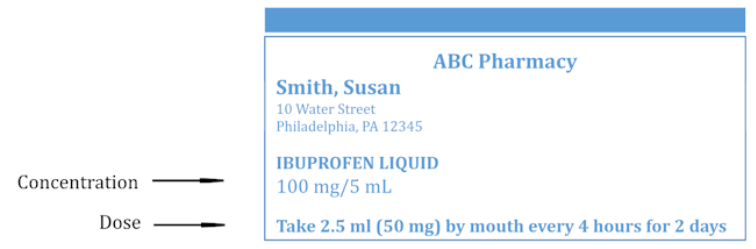
Right concentration: Each drug company and pharmacy mix medicines differently. They combine a certain amount of medicine with a certain amount of liquid. This is called the concentration of the medicine. Some medicines come in more than one concentration.
The concentration of a medicine is not the same as the dose of a medicine.
-
In the example above, 100 mg/5mL is the concentration. This is how the medicine was mixed.
-
In the example above, 2.5 mL (50 mg) is the child's dose. This is the amount to give the child.
|
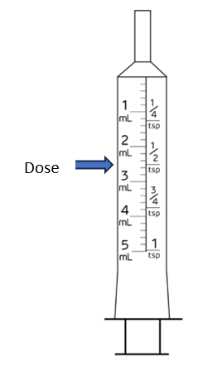 |
Right amount/dose: If you are giving your child a liquid medicine that you bought “over the counter,” such as acetaminophen (Tylenol®), always use the measuring tool that came with the medicine.
If you have a prescription for a liquid medicine, ask the pharmacist for the correct size oral syringe to give the medicine. Each time you fill or refill a prescription, ask the pharmacist to show you the exact amount to give using a syringe. Never use a kitchen spoon to measure medicine.
Caution! Some syringes have markings for both mL and teaspoon (tsp). Always use the mL markings to measure medicine.
Syringes come in different sizes. The size you need depends on the dose of the medicine. Different syringes have different measurement markings (lines on the syringe). Always ask the pharmacist to show you how to measure the dose when you pick up your child's medicine. Below you can see common syringe sizes and their measurement markings.
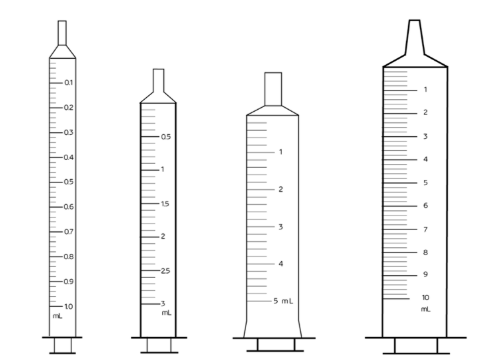
To measure the correct amount of medicine, put the syringe into the medicine bottle or cup and pull the top of the plunger to the correct line on the syringe. Make sure there are no air bubbles in the medicine.
If the dose falls between the lines on your syringe, ask the pharmacist if a better syringe size is available. If not, you may need to draw up the medicine to between the line markings on the syringe. (Example: A dose of 4.5 ml would require measuring the medicine to between the 4.4ml and 4.6ml lines on the syringe).
Right time: The medicine label will tell you how often to give the medicine. Write down the times so you don’t miss a dose.
Right child: Check the label to make sure it has your child’s name.
Right number of days: Some medicines are given long term, and some medicines are given for a set number of days. If your healthcare provider tells you to give the medicine for a set number of days, mark these days on a calendar so you know when to stop.
Right place: Store the medicine as directed on the label.
Call your healthcare provider if you think your child needs a new prescription. Throw away any leftover prescription medicine.
General tips
-
Ask your pharmacist for help. They can suggest the best tool to use, such as a syringe, dropper, or medicine cup.
-
For younger children: When using a dropper or syringe, cradle your child on your lap with their head tilted back. Slowly squirt the medicine along the inside of the cheek, not directly on the tongue. This can make swallowing easier and help prevent choking.
-
For older children: Putting the medicine in a small cup or using a straw may help them feel more comfortable and independent.
-
Have two adults help when possible. One person can give the medicine while the other offers comfort and reassurance.
-
Use comfort positioning or swaddling. Holding your child gently or wrapping them snugly in a blanket can help them feel safe and secure.
Improving the taste
-
Ask your pharmacist about flavor options to help cover the taste of certain medicines.
-
Some, but not all, medicine can be mixed with food and liquid. Check with your healthcare provider or pharmacist to see if this is possible.
-
If your pharmacist says it’s okay, you can mix the medicine with a small amount of food or liquid. Your child must finish the entire amount that you mix. If the mixture is too large, your child may not finish it and will not get all the medicine. Here are some mixing suggestions:
-
Soft food: Applesauce, nut butter, chocolate spread, icing, mashed fruit or potatoes, oatmeal, Jello.
-
Flavored drink: White grape juice (helps hide bitter tastes), other fruit juice, smoothies or milk shakes, sports drinks. Avoid grapefruit or grapefruit juice unless your pharmacist says it’s okay. It can affect how some medicines work.
-
Drink powder: A small pinch of Crystal Light or Kool-Aid to help with the taste.
-
FlavoRx: You can ask your pharmacist to add this to your child’s medicine. It may cost more.
-
Syrups: Most pharmacies have flavored syrups (such as cherry) that you can buy to mix with medicine. Maple, chocolate, and coffee flavored syrups also work.
-
Do not mix with hot or fizzy drinks. These can change the taste or how the medicine works.
-
Some medicines, like antibiotics and iron, should not be given with calcium-rich foods (like milk, yogurt, or cheese).
Blocking the Taste
-
Numb the taste buds. Have your child suck on a popsicle or ice cube before and after taking the medicine. This can make the taste less noticeable.
-
Pinch the nose. Encourage your child to gently pinch their nose while swallowing. This helps reduce the sense of taste.
-
Offer a strong flavor. Give a small amount of something with a strong taste, like chocolate syrup, peanut butter, or a lollipop, before or after the medicine to help cover the flavor.
-
Match the Flavor. If medicine tastes salty, choose something salty to give with it (chips, pretzels, broth). If medicine tastes sweet, choose something sweet (apple sauce, chocolate, fruit).
Call your CHOP healthcare team if:
-
Your child vomits medicine more than once.
-
You are unable to get your child to take the medicine.
-
You think your child is having an allergic reaction (rash, hives).
-
Call 911 if your child has trouble breathing or swelling of the face.
Taking medicine can be hard for kids, but with patience, practice, and the right tools, it can get easier over time. Every child is different; what works for one may not work for another. Stay calm, keep communication open, and celebrate small successes along the way. If taking medicine continues to be hard, talk to your pharmacist or healthcare provider for more ideas and support.
Reviewed January 2026 by Melanie Hoynoski, MPH, CCLS, CTRS, Kerry Hurlbut, DNP, CRNP and Stephanie Li, PharmD