Apixaban (Eliquis)
Blood clot information
-
Blood clots help heal injured blood vessels, but too much clotting can block blood flow, and cause pain and swelling. Learn more about blood clots here.
-
Blood clots can form in the heart, arteries, or in veins. A clot in a large vein is called a deep vein thrombosis (DVT).
-
Clots can also break off and travel to the lungs, causing a pulmonary embolism (PE), or to the brain, causing a stroke. These can be life threatening.
-
Apixaban (also known by the brand name Eliquis®) is an anticoagulant. It helps prevent blood clots and stops existing clots from growing.
Apixaban instructions
-
Apixaban comes in 3 forms based on patient weight. Your anticoagulation management team will tell you which form your child will take:
-
Tablet: for patients who weigh 35kg (77lb) or more
-
Tablet mixed with liquid or food: for patients who weigh 4-35kg (9-77lbs)
-
Sprinkle capsule: for patients that weigh 2.6-4kg (5.7-9lbs)
-
Give by mouth or gastric tube (G-tube) twice a day (12 hours apart), with or without food.
-
Avoid foods and drinks with grapefruit. It may increase the amount of medicine in the body.
-
If your child vomits within 30 minutes of taking a dose, repeat the dose. If it has been more than 30 minutes, do not repeat the dose and wait for the next scheduled dose.
-
If a dose is missed, take it as soon as you remember and go back to the regular schedule. If it is close to the time for your next dose, skip the missed dose and take your next dose at the regular time.
-
Do not give two doses at the same time to make up for a missed dose.
-
Call your anticoagulation management team if you are unsure what to do about a missed dose.
Instructions for taking apixaban tablets (for patients that weight 35kg or more)
-
Tablets come in 2.5mg and 5mg doses.
-
Tablets can be swallowed whole or crushed and mixed with liquid or a small amount of soft food. Crushed and mixed tablets may also be given through G-tube, with a 10ml water flush after administration.
Instructions for mixing apixaban tablets with liquid (for patients that weigh more than 4kg)
Tablets come in pre-filled packets with 1, 3 or 4 tablets in each packet. You may need more than one packet for your child’s dose. Read the prescription carefully for the number of packets and tablets you will need for the dose.
-
Mix tablets with 2.5-10 mL of liquid (water, formula, or juice). Crush and stir until no tablet pieces are visible (about 5–7 minutes).
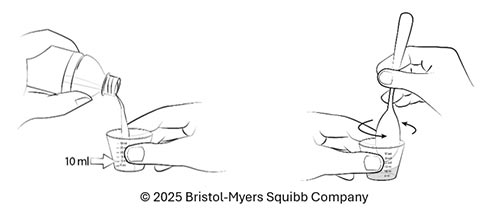
-
Draw the medicine into an oral syringe and give by mouth or G-tube right away (use within 2 hours). Do not put the medicine into a bottle or feeding bag.
-
Add another 5mL of liquid to the medicine cup, mix, and draw into syringe. Give the liquid directly by mouth or G-tube. If giving via G-tube, flush the tube with 10mL of water.
Instructions for mixing apixaban tablet with food (for patients that weigh 4-35kg)
Tablets come in pre-filled packets that may have 1, 3 or 4 tablets in each packet. You may need more than one packet for your child’s dose. Read the prescription carefully for the number of packets and tablets you will need for the dose.
-
Mix tablets with 15mL of food in a bowl. Use only a small amount of food so your child takes the full dose. The tablets do not need to be evenly mixed or dissolved into the food.
-
Give the mixture right away. Have your child sit up and put the medicine directly in their mouth. Make sure no medicine or food is left in the bowl.
Instructions for mixing apixaban sprinkle capsule (for patients that weigh 2.6-4kg)
Sprinkle capsules should be opened and mixed into liquid, not swallowed whole. Read the prescription carefully for the number of capsules you will need for the dose.
-
Twist both ends of the capsule and slowly pull the capsule open over a medicine cup so all the powder goes into the cup. Make sure the capsule is completely empty.
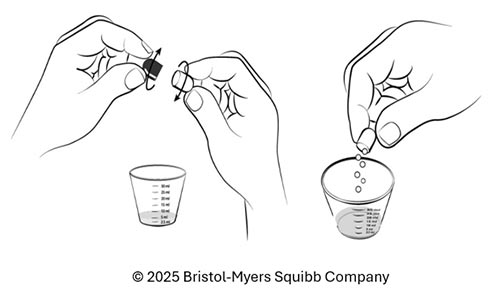
-
Mix 2.5-5mL of liquid (water, formula, breastmilk) into the medicine cup until the powder can’t be seen.
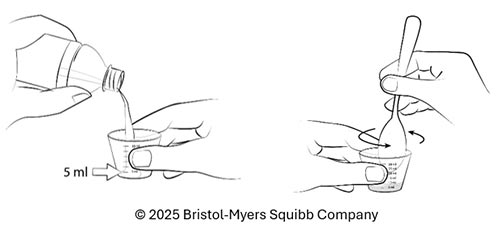
-
Draw the medicine into an oral syringe and give by mouth or G-tube give right away (use within 2 hours). Do not put the medicine into a bottle or feeding bag.
-
Add another 5mL of liquid to the medicine cup, mix, and draw into syringe. Give the liquid directly by mouth or G-tube. Flush the tube with 10mL of water.
Safety Instructions
Anticoagulants can cause bleeding, especially with injuries, surgery, or medical procedures. Staying active is important for health, and safety is key when taking apixaban. It is important to follow these safety tips:
-
Always wear seat belts.
-
Wear helmets and protective equipment when needed (for example, bike riding).
-
Avoid rough contact sports: football, hockey, lacrosse, wrestling.
-
Avoid activities with a high risk of head injury: rock climbing, horseback riding, diving, skateboarding, downhill skiing, snowboarding.
-
Use caution with baseball, softball, and soccer.
-
Plan ahead for dental work, invasive procedures, and immunizations.
-
Ask your healthcare provider or pharmacist before taking any new medicines, vitamins, or supplements. Some can change how apixaban works.
-
Do not take aspirin, ibuprofen, or any non-steroidal anti-inflammatory medicines (NSAIDs). They can increase bleeding when taken with apixaban.
Stay in touch with your care team
Call your anticoagulation management team for:
-
Bleeding (nosebleeds, blood in urine or stool, heavy or prolonged periods)
-
Symptoms of a clot, pulmonary embolism, or stroke
-
Injury
-
Difficulty preparing or taking the medicine
-
Procedures (surgery, dental work, or immunizations)
-
Changes to scheduled appointments
-
Refills: call at least 3 business days before you run out of apixaban.
Hematology Thrombosis Program at Main Campus or Voorhees
|
CHOP Main Hematology patients:
8:30am-5:00pm, Monday-Friday
215-590-3058
|
Voorhees Hematology patients
8:00am-4:30pm, Monday-Friday
856-435-7502
|
|
Cardiac Thrombosis Program
8:00am-5:00pm, Monday-Friday
267-425-6019
|
|
All patients:
Weekends, holidays, and every day after 5pm
215-590-1000 and ask for the hematologist or cardiologist on call.
For non-urgent issues, send your team a message in the MyCHOP portal.
Reviewed January 2026 by Kaitlin Bates, RN, BSN; Connie Law, PharmD; Grace Nelson, MSN, CPNP-AC, CPN