Skin Problems Associated with G Tubes
Important information:
If your child has a G tube (gastrostomy tube), watch for these potential skin problems. Contact your child's care team if you have any questions or concerns.
-
Leaking for balloon G tubes
-
Leaking for long G tubes
-
Mucoid drainage
-
Redness and irritation (erythema) at the G tube site
-
Dermatitis
-
Cellulitis
-
Granulation tissue
-
Enlargement of G tube opening (keyhole)
-
Prolapse
Instructions for leaking for balloon G tubes:
A leaking tube can happen for many different reasons. Figuring out why the tube is leaking is important to prevent other issues like skin irritation. Leakage may be a sign of another problem with the G tube, such as an enlarged opening, granulation tissue, or a tube that does not fit right.
For patients with a balloon G tube or low-profile balloon G tube, the most common reason for a leak is there is not enough water in the balloon.
-
To check the amount of water in the balloon:
-
Hold the G tube button against the belly and pull back on the balloon port with the syringe that comes in your G tube kit. Check the amount of water that you have pulled into the syringe.
-
If there is less than the usual amount, add water.
-
Keep your thumb on the syringe plunger while removing the syringe from the balloon port. This will keep water in the balloon as you remove the syringe instead of flowing back into the syringe.
-
Balloon volumes are different based on size and type of tube. Talk to your healthcare provider about the right amount of water for your child's tube. If the balloon contains the correct amount of water, but is still leaking, add 0.5 ml to 1 ml of water at a time to the balloon until the leaking stops. Never have more than the maximum recommended amount of water in the balloon. If you add too much water to the balloon, it may break or cause a blockage in the intestine.
-
If leaking continues, call your healthcare provider.
-
While you are waiting to get instructions, keep your child's skin dry by changing any wet gauze or dressing under the tube as needed. Protect the skin around the stoma with a skin barrier, such as Vaseline®, A&D® ointment, diaper cream, or Cavilon™ No Sting Barrier Film (if your child is over 1 month of age)
Watch this video for instructions on how to check the water in your G tube balloon.
Instructions for leaking non-balloon G tubes:
-
If your child has a mushroom G tube with a Hollister device, make sure the mark on the tube is still at the Hollister strap. If it is not, gently tug on the tube and secure it with the Hollister device. This brings the mushroom tip of the G tube up against the inside of the stomach. If leaking continues, call your healthcare team.
-
If your child has a non-balloon G tube, call your healthcare provider if the tube is leaking.
-
Keep your child's skin dry by changing wet gauze or dressing under the tube as needed.
-
Protect the skin around the stoma with a skin barrier, such as Vaseline, A&D ointment, diaper cream, or Cavilon No Sting Barrier Film (if your child is over 1 month of age).
Instructions for mucoid drainage:
After surgery, there is an expected drainage that we call "mucoid" drainage, which looks like mucus.
It can be thick or thin, and sometimes stringy like mucus and is usually a yellow or green color. You may also see dark brown or red drainage. This is bloody drainage from the healing tract (opening from the skin into the stomach).
This picture shows normal mucoid tissue drainage that we expect to see after surgery. This drainage is not a sign of an infection.
-
If your child has drainage, put a dressing around the G tube to absorb it. Your healthcare provider can help determine which dressing is appropriate.
-
Clean the skin around the G tube at least once a day with warm, soapy water. Dry the skin around the G tube well after cleaning.
Instructions for redness and irritation (erythema) at the G tube site:
Erythema is a mild redness or pinkness around the G tube and is a common skin problem that is seen after a G tube is placed.
Often the skin becomes irritated from the new G tube device itself, or from drainage from the site. It can also be caused by an G tube that does not fit well. For example, when the G tube button is too tight, it causes pressure on the skin that can lead to redness.
-
Clean the skin 1-2 times a day with warm soapy water and dry the skin well after cleaning.
-
Protect the skin around the stoma with a skin barrier, such as Vaseline, A&D ointment, diaper cream, or Cavilon No Sting Barrier Film (if your child is over 1 month of age).
-
Check the size and fit of your child's tube. The G tube should easily turn and should not leave marks or indents in the skin. If your child has a dressing around their tube and you suspect the erythema or redness is related to the type of dressing, call the General Surgery team for guidance. Redness or pinkness that is spreading away from the G tube site can be a sign of infection. If the redness is close to or just around the G tube button itself, it is likely not an infection. This picture shows a good example of local erythema that would not raise concern of an infection.
-
If the redness extends further outward from the G tube in a circle and is very tender to touch, your child may have a skin infection. Any movement of the tube may be painful. Call the General Surgery clinic at 215-590-2730. Your child may need antibiotics.
Dermatitis
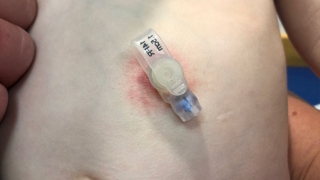
Redness and skin irritation at G tube button.
Dermatitis is skin irritation. It is often related to the skin being exposed to drainage from the G tube site. Stomach acid can be very irritating to the skin. Dermatitis can be uncomfortable to the touch, like a bad diaper rash.
If your child has dermatitis, wash their skin with warm, soapy water 1-3 times per day. Dry the skin well after washing. Apply barrier cream, such as a diaper cream, to the skin around the G tube to prevent this irritation.
Cellulitis
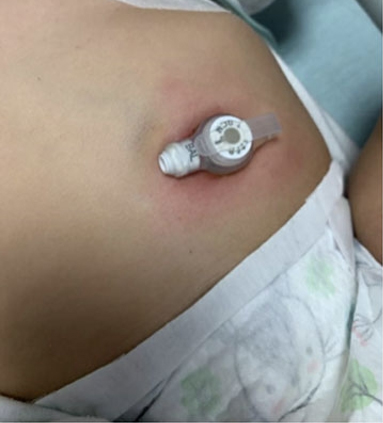
Cellulitis is an infection that can best be described as redness plus skin being warm to the touch, swollen, and painful.
When erythema (redness) is from cellulitis, the redness around the G tube site extends further outward in a circular fashion. See the picture below (prior to antibiotics) for an example of what cellulitis can look like.
In this circumstance, the G tube is often very tender to touch, and any movement of the tube will likely cause your child significant discomfort.
If you see skin with this appearance, call the General Surgery clinic at 215-590-2730 to discuss. We will often request a picture of the G tube and surrounding skin for evaluation, which can be sent as an attachment through your MyCHOP account.
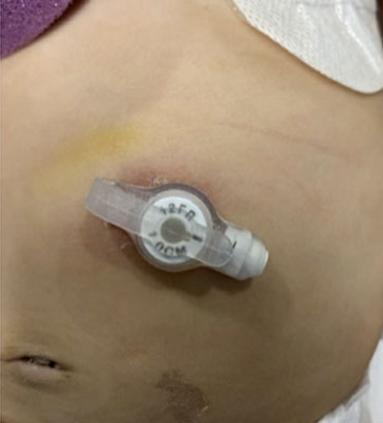
The treatment for cellulitis is antibiotics. Antibiotics will help to resolve the redness and the related tenderness (see image after antibiotics).
TABLE 1
 |
 |
| Prior to Antibiotics |
After Antibiotics |
Instructions for granulation tissue:
Granulation tissue (also called hypergranulation tissue) is a type of scar tissue that forms when the body is trying to heal itself. Because the feeding tube stoma is a new opening, your child's body naturally may try to close it by growing this tissue. Some children have granulation tissue that grows very quickly, while others have no problem with it at all.
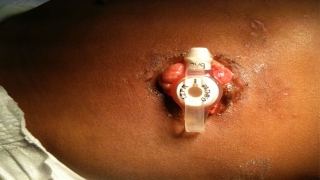
Granulation tissue (hypergranulation tissue)
Granulation tissue is dark pink or red, can feel spongy or firm, and have a bumpy, bubble-like appearance. Sometimes it can cause leaking and skin irritation. It may also bleed or cause pain. If this happens contact your healthcare provider.
-
If you see granulation tissue starting to grow, discuss it with your healthcare provider at your next visit.
-
If the granulation tissue around the tube is bleeding, painful, or growing quickly, contact your healthcare provider for an appointment. They may prescribe a cream that you can use at home, or they may treat it in the office with a medicine called silver nitrate. These medicines shrink the granulation tissue. Granulation tissue may return and need to be treated with medicine again.
Instructions for enlargement of G tube opening (keyhole):
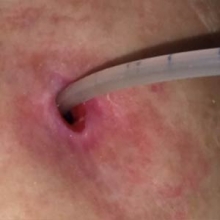
Stoma with keyhole opening.
An enlargement of the G tube opening (stoma) can happen when the tube pulls or tugs along the stoma. This slowly widens the stoma over time. This may also be called a keyhole opening.
A keyhole opening is a result of a pulling on the stoma from the extension on the tube. This can happen if the extension set is always attached, the extension is taped/secured in the same position or not properly taped, or if it puts tension on the G tube (too tight).
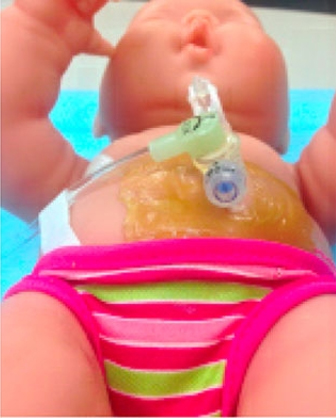
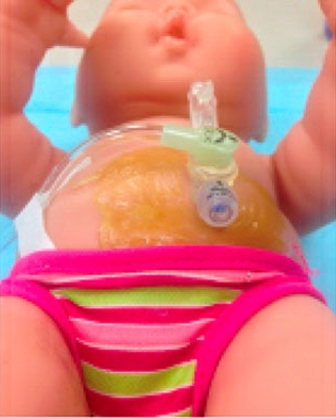
The goal is to have the tube remain as perfectly straight as possible. Relieving tension allows the stoma to heal and prevents the opening from getting larger. We recommend removing the extension set after a feeding is done and medicine has been given. Position the extension set so that it does not put tension on the G tube.
The picture below shows how to properly secure the extension when it is attached to the G tube so that it does not put tension on the tube.
TABLE 2
 |
 |
| Tensed Securement |
Appropriate Securement (no tension) |
Instructions for prolapse:
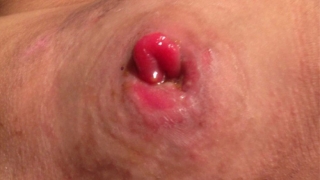
Prolapsed stomach tissue
Prolapse is when stomach (gastric) tissue slips forward and can be seen on the outside of the skin. This can happen from pressure on the stoma, either from the inside of the stomach, or outside by the G tube. For example, layers of dressing underneath the G tube can pull the balloon to upward inside of the stomach. This pressure can then cause the balloon to enter the tract.
Prolapse often is confused with granulation tissue. Prolapsed stomach tissue (mucosa) may look deep red like raw beef with a velvety, smooth appearance. Granulation tissue is usually pink, feels spongy or firm, and has a bumpy appearance.
Prolapse can lead to increased leaking from the G tube site. Although it is not an emergency, if you are concerned for stoma prolapse, call the General Surgery team at 215-590-2730. We will often ask you to send us a picture of the tissue to examine. Pictures can be sent as an attachment through your MyCHOP account.
Reviewed May 2025 by Lauren Agzigian CPNP-AC,CRNP, MSN, BSN, RN