Vitamin D
Important information about vitamin D:
-
Learn more about Vitamin D.
-
Vitamin D is a fat-soluble vitamin. The fats in foods help these vitamins to be absorbed in our gut. Vitamin D is found in some foods, but our main sources of vitamin D come from supplements (tablets, capsules, or liquids) and the sun.
-
Vitamin D helps your body absorb calcium. All children need vitamin D to grow and to have healthy bones and teeth. Vitamin D is also important in maintaining the health of our muscles and our immune system. Studies suggest that vitamin D plays a role in decreasing the risk of many chronic diseases, such as arthritis, cancer, diabetes and high blood pressure.
-
Vitamin D dosing depends on your child's health. Recommended vitamin D doses are:
-
Healthy infants 1 year of age or younger: 10 mcg (400 units) daily
-
Healthy children older than 12 months of age: 15 mcg (600 units) daily
-
Children with medical conditions may need extra vitamin D
-
If your child does not get enough vitamin D from what they eat and drink, a Vitamin D supplement can help. Your healthcare provider will tell you how many micrograms (mcg) or units of supplemental vitamin D to give your child each day.
Important information about vitamin D supplements:
-
There are two forms of vitamin D found in foods and supplements.
-
Vitamin D2 (ergocalciferol): available by prescription or as an over-the-counter product.
-
Vitamin D3 (cholecalciferol): available as an over-the-counter product. It is generally better absorbed than vitamin D2.
-
Some over-the-counter vitamin D supplements may contain other vitamins or minerals. Contact your healthcare provider before using these supplements.
-
Product labels for vitamin D supplements show the strength and concentration in micrograms (mcg) instead of units (IU). Note that 10 mcg of vitamin D is equivalent to 400 units.
-
If your child is following a specific diet, carefully read the label to identify ingredients that you need to avoid. If you still have questions about the product, contact your healthcare provider.
-
Vitamin D supplements can be found at your local pharmacy in the vitamins and minerals section.
-
If the supplement is not available at your pharmacy, you may need to buy it on the internet. Speak with your healthcare provider before ordering any vitamin D supplements from the internet.
-
Choose USP verified products, when possible, to ensure quality. Browse the full list of USP Verified Products.
-
If a USP verified product is not available, here is a list of other vitamin D supplements you may consider:
Follow these instructions for giving vitamin D supplements:
-
All products: give with food to improve how it is absorbed into the body. Vitamin D is available in many different dosage forms and concentrations; pay extra attention when reading labels.
-
Liquid products: carefully read the concentration of your home product. This will determine how much medicine volume you will need to give your child's prescribed dose.
-
Use the label to find how many micrograms (mcg) of medication are in the "Amount Per Serving" section.
-
Look at the package label to find the concentration (mcg per ml OR mcg per drop).
-
Then use the label to find how many milliliters (mL) or drops the "Serving Size" is. "Amount Per Serving" divided by the "Serving Size" will be the concentration.
-
If the concentration of your liquid product doesn't match what your healthcare provider recommended, contact them to clarify how to give your child's dose.
-
Pay attention to how your child’s vitamin D is packaged. The way you give the medicine depends on the bottle type.
Bottle with dropper tip
If the dose does not round to a full drop, contact your healthcare provider. You may be able to remove the dropper tip and use an oral syringe
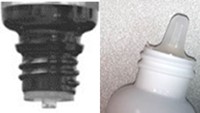 |
| Bottle with dropper tip |
instead.
By mouth:
-
Put the prescribed number of drops in a small amount of water, milk, or soft food.
-
Do not mix with other medicines.
-
Make sure your child takes the full amount, so they get the full dose.
-
Do not drop directly into your child’s mouth. This may give too much by mistake.
-
For infants: place the drops on a clean fingertip, pacifier, or mother’s nipple and let the baby suckle for 30 seconds.
By feeding tube:
-
Mix the drops in 1–2 mL of water or milk.
-
Draw up the entire mixture into an oral syringe.
-
Give through the feeding tube as you were taught.
|
|
|
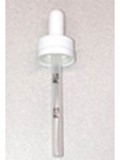
Bottle with dropper syringe
|
Bottle with dropper syringe
By mouth:
-
Only use the dropper syringe if it came with the vitamin D bottle; dropper syringes are not interchangeable between different brands.
-
Gently tilt the syringe toward the inside of your child’s cheek to give the dose.
By feeding tube:
Bottle with oral syringe
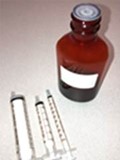 |
| Bottle with oral syringe |
If your child’s dose is smaller than 0.05 mL, it is too small to measure with an oral syringe. Ask your provider about a different product.
By mouth:
By feeding tube:
-
Use the smallest size oral syringe that fits the full dose.
-
Give the medicine through the tube as you were taught, including flushing with water after giving.
Additional information about foods that provide vitamin D:
-
Pink salmon, canned, 3 ounces: 13.25 mcg (530 units)
-
Tuna, canned, 3.5 ounces: 5.75 mcg (230 units)
-
Fortified milk, 8 ounces: 2.5 mcg (100 units)
-
Fortified orange juice, 8 ounces: 2.5 mcg (100 units)
-
Infant formulas, 8 ounces: 2.5 mcg (100 units)
-
Fortified yogurts, 8 ounces: 2.5 mcg (100 units)
-
Fortified cheeses, 3 ounces: 2.5 mcg (100 units)
-
Fortified breakfast cereals, 1 cup: 1 mcg (40 units)
-
Egg yolk, 1 large: 0.5 mcg (20 units)
*Listed values are examples. Actual vitamin D content may vary between different products and brands.
Call your CHOP healthcare provider with any questions or concerns.
Reviewed September 2025 by Stephanie Li, PharmD