Psoriasis: How to Care for Your Child
Psoriasis (suh-RYE-uh-sus) is a condition that causes a skin rash, and sometimes joint problems and nail changes. It's a long-lasting (chronic) condition that can get better or worse at times. It may begin at any age and can run in families. It is not contagious (does not spread from person to person).
Although psoriasis cannot be cured, treatment can help control symptoms. Your health care provider will work with you to figure out what treatment works best for your child.
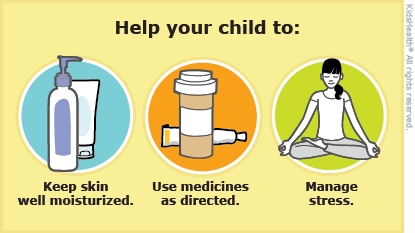

Follow your health care provider's instructions for:
General care:
-
Remind your child to keep skin clean and well-moisturized to help reduce itching and soreness. Encourage your child to use a moisturizer or petroleum jelly right after a bath or shower.
-
Encourage your child to spend time outdoors. Natural sunlight in small amounts can help improve the symptoms of psoriasis.
-
Keeping a healthy weight can be helpful for people with psoriasis, so make sure your child eats a healthy, balanced diet and gets lots of physical activity.
-
Help your child manage stress. In some kids, stress can make psoriasis worse. For some, the skin rash can be a source of stress, sadness, or anxiety. Ways to help your child cope with stress include:
-
Infections (like strep throat or a cold) can trigger a psoriasis flare-up. To help prevent infections:
-
Smoking can make psoriasis worse. Make your home and car smoke free. For help quitting, call 800-QUIT-NOW (800-784-8669) or visit smokefree.gov.

Your child:

What happens with psoriasis? Children with psoriasis have red patches of thickened skin (called plaques) that may burn, itch, or feel sore. The plaques are often covered with silvery scales. Plaques are often found on the scalp, elbows, knees, palms, and soles of feet, but they can happen anywhere on the body. Children with psoriasis also may have changes to the fingernails or toenails. When joints are affected, they can be painful, stiff, and swollen. (This is called arthritis.)
What causes psoriasis? The exact cause of psoriasis isn't known. But experts do know that the immune (disease-fighting) system is involved. Immune system cells become overactive, causing skin cells to grow faster than they can be shed, and they pile up as plaques on the skin. Some medicines, stress, infections, and smoking can make psoriasis worse.
How is psoriasis treated? Treatments for psoriasis work by slowing the growth of skin cells or controlling the immune cells that lead to psoriasis. These include:
-
Ultraviolet light therapy (natural or artificial light)
-
Skin treatments, such as creams and ointments
-
Medicine in liquid or pill form taken by mouth
-
Medicine injections (shots)
Sometimes more than one treatment is needed to help control symptoms.
Does my child need any other tests? People with psoriasis have a higher chance of developing other medical conditions, like high blood pressure, heart disease, cholesterol problems, and diabetes. Talk to the health care provider to see if your child should be screened for any of these.