Bronchiolitis: Caring for Your Child
Your child was in the hospital to get medical care for the coughing, wheezing, and other problems caused by bronchiolitis. You can now care for your child at home. He or she should feel better in a week or so, but the coughing may continue for several weeks.

-
Try using a cool-mist humidifier, especially when your child is sleeping. Clean the humidifier after each use.
-
For a baby with a stuffy nose, you can help get the mucus out with saline (saltwater) drops and a bulb syringe:
-
-
Put two saline nose drops into your baby's nose.
-
Use a bulb syringe to clear the mucus.
-
Try not to use the bulb syringe more than three times a day because it can hurt the inside of your baby's nose or cause it to swell.
-
Make sure your child drinks plenty of liquids. If your child can't drink a lot at once, give small amounts of liquid more often using a spoon or medicine dropper.
-
If your child has a fever, don't give aspirin. If the health care professional says it's OK, give one of the following exactly as instructed:
-
-
acetaminophen (brand names include Tylenol® and Panadol®)
-
ibuprofen (brand names include Advil®, Motrin®, and Q-Profen®)
-
Don't give any cough or cold medicines to children under 6 years old. They can cause serious side effects. Ask the health care professional before you give cough or cold medicines to children older than 6.
-
Don't allow anyone to smoke around your child. Smoke makes kids cough and wheeze more. It also causes more lung infections.

Your child:
-
Is breathing faster than usual.
-
Is not eating or drinking.
-
Has any of these signs of dehydration:
-
-
a dry or sticky mouth
-
peeing less
-
no tears when crying
-
Has a new or higher fever.
-
Is still coughing after 3 weeks.

-
Your child is short of breath.
-
During breathing, your child's nose flares out or the muscles between the ribs pull in.
Call 911 if your child is struggling to breathe, is too out of breath to talk or walk, or turns blue.

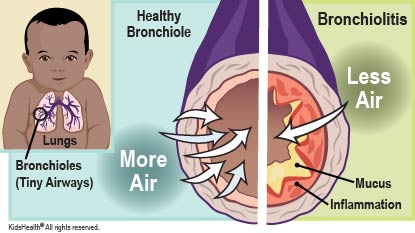
What causes bronchiolitis? Kids get bronchiolitis because a virus like RSV (respiratory syncytial virus) gets into their lungs. These viruses can irritate tiny airways called bronchioles. The airways swell and fill with mucus, making kids wheeze.
How is it treated? There are treatments that help while kids get better from bronchiolitis. Antibiotics don't work because bronchiolitis is caused by viruses, not bacteria.
Can bronchiolitis spread to others? The viruses that cause bronchiolitis can spread from one person to another. Keep your child home from school or child care until there is no fever or runny nose for at least 24 hours.
To help prevent the spread of viruses, all family members should:
-
Cough or sneeze into a tissue or into their elbow or upper arm (not their hands).
-
Wash their hands often using soap and water. Scrub for at least 20 seconds, rinse, and dry thoroughly. This is especially important after coughing or sneezing and before eating or preparing food. If soap and water are not available, a hand sanitizer with at least 60% alcohol can be used.
Can bronchiolitis cause any long-term problems? Kids who were in the hospital for bronchiolitis as babies may wheeze more often than other kids. But after age 10, their chance of wheezing is about the same as that of other kids.
Can bronchiolitis come back? Because lots of different viruses can cause bronchiolitis, kids may get it more than once — just like a cold or the flu. Hand washing is the best protection against viruses.